Saturday, November 03, 2012

Waxing Philosophical on Time Travel and Star Trek


Be aware, you are about to experience some full-frontal nerdity if you keep reading.  I have a theory regarding the often contradictory (and perhaps overdone) use of time travel in the Star Trek narrative.  This theory covers all six shows (yes, I in fact count the Animated Series (TAS), and even Voyager (VOY) ) and the new timeline which I think was masterfully created in the 2009 film Star Trek. 

For a while now I have been involved in a play-by-email role-playing game set a few years after the Dominion War in the Prime Trek universe.  In case you aren’t familiar with that term, the script for the 2009 film used it to designate the continuing narrative which started with the Original Series (TOS) included all the series through Enterprise (ENT), and the first ten films.  Therefore, Leonard Nimoy’s character was referred to as “Spock Prime” being from the original timeline.  Anyway, the RPG has been a lot of fun (shout out to Steven and the gang) and is really more a form of collaborative writing than rolling dice.   My only complaint is I don’t always have the time to dedicate to the stories that they deserve, but while sitting in the middle of the desert with my Firm watching people steal porta-johns (true story), I will often shake my head in disbelief and escape internally to thinking about fiction that needs writing, including the Game.  This particular story involves the political and scientific dealings with the planet that houses the Guardian of Forever, made famous in what is widely regarded as the best of TOS, the episode “City on the Edge of Forever.”  So, the different examples of time travel and methods thereof in Trek have been on my mind as I collaborate with fellow fans to tell this story.  What I have realized is the descriptions and uses seen in the original episode with The Guardian do not make sense unless they are incomplete.


I am well aware of the controversy surrounding the great Harlan Ellison’s original version and what made it to TV under the hand of the great Gene Roddenberry.  However, in this discussion, I plan to use only what has appeared on screen as official or “canon” information.  You will see that some of Ellison’s original intention made it into the aired version, though changes left some inconsistency.  Yes, I know the real world storytelling reasons behind problems I will point out, but I am arguing in universe.

Quick diversion: Once upon a time fans of a particular thing loved that thing and would vehemently defend it even in the evidence of narrative error.  In the 70s and 80s there was a magazine called “Trek Magazine” (I know, not very original) dedicated to pointing out how inconsistencies in Trek episodes were not in fact inconsistencies at all, and providing explanation.  Marvel Comics for years gave out the “No-Prize;” not for pointing out a mistake in a comic, but for pointing it out and explaining why it wasn’t really.  Look, when you have literally hundreds of contributors to a narrative over decades things are going to slip through the cracks.  We as fans once accepted that and rolled with it, helping the Powers That Be out when necessary.  Now it seems fandom exists to decry the things it loves.  Maybe it’s the internet’s fault, maybe it’s because fans hold things in higher regard than entertainment is worthy of, I don’t know.  I’ve been guilty of some of this bashing myself.  Could be time to stop.  Or, if you didn’t like something, STOP WATCHING IT.

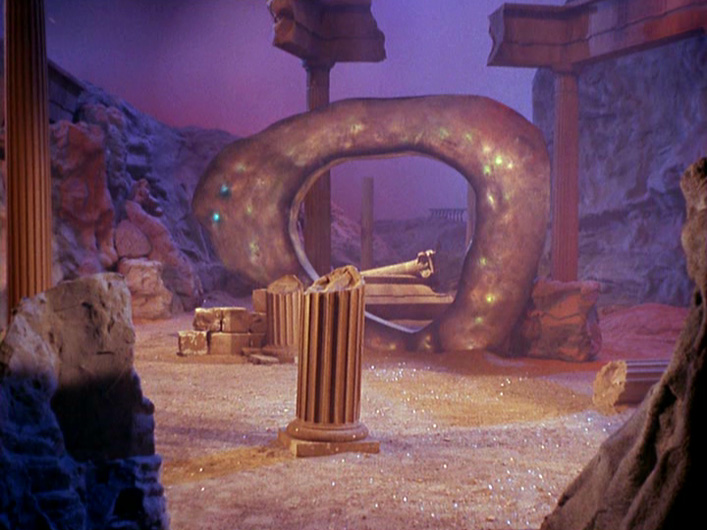
Back to my original point:  I wish to make two assertions. One, there is in fact NO Prime timeline in Star Trek.  Rather the shows are scattered about similar, even interactive timelines and causality chains created when characters from one change what’s in another.  Two, the timelines of Trek are similar and linked because of a central hub to their existence: The Guardian of Forever.  It is not just a lumpy doughnut you can time travel with.


Trek 2009 illustrates the first point very well.  When something alters the existent chain of events that defines a timeline, the timeline does not change, but rather a new divergent path is created.  I am not arguing a la Schrödinger that every decision creates a new timeline, but rather only when one is externally altered.  Evidence of these parallel timelines all already well established in Trek: the Mirror Universe being the most obvious.  The sideways universe in Voyager’s “Year of Hell” would be another, or the timeline shown in the final VOY episode where it took them 16 years to get home.  I think however there are more, a lot more and indeed from our perspective as outside observer, Star Trek: The Next Generation  (TNG) takes place over at least three different timelines, possibly more.  TOS does not take place in the same timeline as VOY or Deep Space Nine (DS9), and perhaps not even in the same timeline as The Wrath of Khan. 


A very similar set of events to the TOS we observed did precede those stories, but not the exact narrative because of altered histories.  I would argue TOS, which clearly puts The Eugenics Wars in the 1990s is somehow separate from the Khan in TWOK claiming he was on Earth “two hundred years ago.”  If we assume TOS takes place in the 2260s (and honestly, most Trek dates are conjectures based on the year 2363 given by Data in the first season of TNG) then TWOK is in the 2270s or 2280s (Kirk mentions a man he hasn’t seen in 15 years).  Two hundred years earlier puts Khan firmly in the mid to late 21st Century.  Sure, figure of speech, etc., but Khan is brilliant and dramatic.  He might use hyperbole, but I doubt he would undercut.  However, we see the VOY cast specifically go to 1996…and there is no devastating Eugenics War.  In DS9 we see them visit the 2020s and an America clearly heading toward trouble… like the trouble First Contact shows us the world recovering from in 2063.  World War Three, presumably Colonel Green’s war which ENT would indicate includes ideas of genetic purity. 

Now, look at TNG episode “Parallels” which actively shows Worf bouncing between similar yet different universes.  Some are so similar as to escape basic notice.  Some are variations so different as to drastically alter known history.  One of Worf’s main indicators (and the audience for that matter) of his dislocation is the shield hanging on the wall in his quarters.  Remember, though Worf passed through the quantum fissure on the shuttle on his way back to the Enterprise, he doesn’t start jumping realities until he is in proximity to Geordie’s VISOR.  Therefore, the Enterprise on which the episode begins is this Worf’s original ship.  When he enters the party in his quarters, there is a round shield hanging to the left of the doorway, and it and other decorations change as the shifting begins.  At the end of the episode, Worf returns—supposedly where he should be—to his quarters.  The shield is not there.  We the observer are not in the universe we started in.  
Before.
After.


TNG shifts again at least once.  In the aforementioned First Contact the Enterprise under Picard goes back and assists Zephram Cochrane against the Borg and to make the first warp flight.  As we will see in ENT this has lasting effects when a chunk of Borg sphere is found a century later in Antarctica.   I propose First Contact creates an entirely new version of the 22nd Century.  Indeed, perhaps this is why the Temporal Cold War has a front here, why the NX-01 seems to be so much more advanced than it should be, and indeed why in Trek 2009 the Kelvin—before any changes have been made by Nero—has a crew of 800.  The opening scene is not in fact in the TOS timeline but a version changed by the Enterprise-E’s presence in 2063.  Multitudes of timelines overlayed and interacting, but on some level distinct, yet close enough to provide us a fairly coherent, if not perfect narrative.  Something has to link all of this together.  The chains of events, emergent personalities (look at the success of Kirk in ANY of these timelines), are linked somewhere.  Something is affecting these timelines to make sure they stay on a basic track. Something makes sure the eddies and flow of time bring Kirk and Spock to the right place in the 1930s to find McCoy.  Something makes sure the Enterprise happens to intercept and finally assist Gary Seven in the destruction of a warhead.  Something makes sure 22nd Century Earth gets a boost of future tech before “Future Guy” starts giving tech to the Suliban.  Something makes sure Picard will be ready to fight an outbreak of anti-time, that Sisko will be drawn to the wormhole, and that old Spock will be in a cave on Delta Vega to keep yet another version of Kirk on track.  Either the entire universe(s) is based on ridiculous coincidence or time in the Star Trek narrative has a protector, a guide, a…Guardian.

The very title “Guardian of Forever” tells us it is not just a lazy gate waiting five billion years for someone to step through (“since before your sun burned hot in space…”); rather we have evidence something is holding the Treks together and there are only a few other candidates for doing so.  Q?  Perhaps, but VOY in their Q stories show us the fallibility of that being/race.  I have always kind of held out that Q was in fact the eventual evolutionary fate of the Human race, but either way we see a limited pervasiveness and interest from the Q in Federation affairs, basically the humans.  Whatever is making the Trek universe tick covers all of existence and not just Q’s pet Picard.  The Preservers?  We know they have been around a while, and may even be the humanoid progenitors of life in the Alpha Quadrant as discovered in the TNG episode “The Chase.”  The however seem far more likely to affect things on a temporal scale (get on our ship, we are taking you somewhere safe so you don’t get wiped out).  Same goes for Gary Seven’s bosses.  Far too grounded by recruiting locals from a time for a time…though there may be no reason to think there isn’t a connection. 

Further, look at the incongruities we see in the episode.  The Guardian claims no builders (I am my own ending, my own beginning).  Yet, later it tells Kirk and Spock it cannot change the speed at which it shows time because of how it was made.  This really just gives it an excuse to put Kirk where it wants to: Long enough before McCoy to fall in love with Edith Keeler.  That’s right, the Guardian is not just letting them fix time, it’s grooming James Kirk.  It is here we see Kirk cast aside the woman he loves for a greater good.  This defines who Jim Kirk is, and continues to for decades.  The Guardian needs Kirk a certain way.  The Guardian admits to Spock’s description that it is a portal to other times and dimensions.  This is why Spock, falling into the same Black Hole in 2383 doesn’t fall back as far as Nero; he won’t be able to stop the Narada on his own, or even help the Kelvin stop it.  The Guardian ensures he will be in Kirk’s life at the right moment to shape the Kirk in this new variant timeline.  It remains unchanged as the universe seemingly shifts around it after McCoy’s alterations of history.  I submit that the Guardian is the central point around which all possible Trek timelines and dimensions flow, and it takes active interest in keeping these universes in a particular shape.  Not always exactly the same, but connected and similar, perhaps as support structures within the quantum foam to keep a particular bubble, or cluster of bubbles, from popping.  The Guardian of Forever is the Star Trek universe. 

Yes, outside actors will change things (Nero, Future Guy on ENT) but in the end, the Guardian will make sure the universe is.  The Guardian abides to coin a phrase.

So, next time you’re getting caught up on some Trek, wondering why the Enterprise just to happens to end up in the 20th Century:


Or Picard happens to be at the center of a chronal paradox:


 Or Janeway happens to be able to tweak a divergent timeline out of existence by the end of the season:


Or Sisko happens to have become commander of the station nearest the beings who may have created him:

Or Archer happens to run into a race from the 24th Century he should know nothing about:


 ...remember it is no coincidence.  The Guardian is watching.


All images property of Paramount or CBS.  Images borrowed from the awesome http://www.trekcore.com/

Tuesday, October 30, 2012

The Official Black Owl Review of "Cloud Atlas."


I’m writing this right now in 2012 on a 2008 Macbook because a guy named Ed Yarborough bought a southern Arizona radio station in 1992.  Oh, and because of a butterfly ballot in Florida in 2000.

See, I worked for an FM rock station in Sierra Vista, Arizona starting in 1990, but in mid-1992 the competition purchased us outright.  There was talk that we would not be fired, and the format wouldn’t change, but I wasn’t buying that.  I was 20 years old and already had a wife and baby; I was not going to base the ability to feed my son on the word of a small town media mogul.  So, I joined the Army.

In 2000, the butterfly ballot in Florida was arguably responsible for the selection of the President.  Three years later, the winner of that dispute invaded a country in the Middle East.  The War would go on for the next nine years.

In 2008, I returned from my second deployment to that Middle Eastern country, and with extra money earned during deployment purchased the very laptop upon which I now type four years later.  (It’s a Mac; she’ll last forever.)

So here’s this chain of seemingly unrelated events that can be traced back from my present to my past, or forward from the 20 year old boy I was to the 40 year old man I am; I am who I am because of events like this chained together through my life. 

And, I have interacted with people: an out of work actor from New York who took a temp job as a translator for the Army in Bosnia; a man with a Doctorate in Physics who took an enlistment in the US Army to expedite his citizenship (and was still only an E4); a former member of the clergy who left the Church in anger; a woman I replaced in not one but TWO assignments through the years who happened to have graduated from my High School thirteen years before me. 

All the ripples they made in my life and service, all there because of events or people in their own lives like those that influenced me in a repeating cycle of cause and effect running back through the people around us, and our own forbearers.  Again, I am here in part because someone named Forrester decided to leave his home town and go to England in the 1300s, and then that person’s descendent—now going by Foster—decided to leave that home and head for a new continent in the late 1700s. 

These ripples, these connections, this web of human interaction and action and the consequences thereof: that is the central theme of the film “Cloud Atlas.”


 Is the film “about” reincarnation?  No, I don’t think so.  It would be easy to say yes, and any given character played by a single actor (Tom Hanks alone plays no less than six characters, and Jim Sturgess seven!) is intended to be that person reborn, or anyone who shares the comet shaped birthmark is indeed a soul returned.  IN places, characters react as if they remember one another from each story.  Rather, in retrospect I think that’s almost just a red herring.  The idea isn’t the actor; it’s the theme behind characters who recur between the six different stories.  In the final (chronological) story, Hugo Weaving plays not just the heavy, but also seemingly a figment of Tom Hanks’ goat herder’s imagination.   Not nearly as disturbing as Weaving’s gender switching portrayal of a Ratchet-like nurse in a 2012 rest home in England.  Point is, that nurse was not reincarnated into a hallucinatory devil… it’s the, well the character of the character.  If the familiarity between 1970s Tom Hanks and Halle Berry does come from the idea their souls were together elsewhen, then it is a bold statement, as they truly come together in the final story.  It speaks to an amazing idea I have myself toyed with that if the soul does return to another living existence in this world, there is no reason it should be constrained by linear time; my next life could be a thousand years ago.

As with any great work of art, the film’s subject to interpretation of course; perhaps it was exactly reincarnation, but to me the joy was watching the connections between the stories play out, the seeds planted on a ship in the 1850s coming to bloom in a future some 100 years after a cataclysmic fall of civilization… a single object affects two men thousands of years apart, but one that wouldn’t be there without the connected threads of history stretching back and forth throughout time.  A struggle in the mid 22nd Century provides a religion for the distant future.  A book written in one time by a character provides another time frame’s character a distraction.  This connectivity speaks to the human condition whether one accepts the spiritual overtones or not: we are connected; all of us, and the actions of any of us can affect all of us. 

How connected are the six stories?  Some more strongly than others, some explicitly, some implicitly (is the composer’s dream in the 1930’s really of Somni~451’s Fabricant café in Neo-Seoul two hundred years later?  Has Luisa Rey in 1975 really heard the “Cloud Atlas Sextet” somewhere before?) but it may be a simple statement that history—great and small—is a cycle.  Anyone who’s read Strauss and Howe’s work on the repeating 80-year cycle of American history can understand that*.  As situations happen again (this has all happened before…) we see whether or not humanity has the capacity to learn from what has gone before.  Keep in mind as well, any one of these stories could work independently.  Separately, each would be a fine diversion; woven together they get to what really gave me joy when watching this film.

It’s about the art of storytelling.  The film opens and closes on a wizened storyteller relating some series of events which may or may not include these tales.  Each timeframe is about someone who is themselves trying to have a story told: be it an abolitionist’s trip to the south seas; a young composer telling the love of his life about the work he is doing at the feet of a more famous (but fading) composer; a journalist getting to the bottom of some form of nuclear power conspiracy in the 70s; a publisher in 2012 relating his forced incarceration in a rest home as a book; a manufactured human in the 22nd Century trying to tell the world she feels, is alive, loves; two people from entirely different survivor cultures post-apocalypse trying to tell those who already left Earth what has happened to those who stayed behind; and again to our ancient raconteur putting it in context.  The film itself is masterful storytelling that steps into the realm of metafiction to celebrate masterful storytelling.  I could get into the set pieces—any one of which would be worthy of notice if the segment were itself a film—or the makeup taking well known actors and transforming them across ethnicity or gender to make sure we understand the most important connection these characters all have: They are human. 


I have spoken elsewhere about my feelings of humanism driven not in spite of, but rather by my faith.  These stories, this film, spoke to me on that level, not trying to hide the ugly side of human existence, but still exalting what we can do when we bother to acknowledge our interconnectedness.  It defies the idea that natural order is one group over another, but rather that natural order is…us.  We the living, all God’s children, the whole of the race, whichever system’s phraseology you want to use.  “Cloud Atlas” is indeed an abridged atlas of the geography of human history, the hills, the valleys, the obstacles, the roads, and those too are us. 

It is not a film for everyone, and it does play a little long in some places.  However, it’s the first time in a long time (dare I say since the Wachowskis gave us the original “The Matrix”) I have seen a movie that strove for true originality and didn’t just regurgitate the formula labeled “popular film.”  I can’t wait to see it again…multiple times.


*If you have not read “Generations: The History of America’s Future from 1584 to 2069” you absolutely should. Published in 1992 with a strong and strengthening economy, the authors predicted a new depression would start somewhere between 2007 and 2012.  The book is a fascinating study of just how much we are slaves to history. 

(Images property of Warner Brothers)

Monday, July 23, 2012

Look Up


I don’t think it’s a big secret that tastes change with age.  Experience tempers us into a different person given enough time; sure, the basics stay the same, but the details will shift and shape according to the things that have come along to stunt or enhance us. 

There was a time I was very much a “strike back” kind of guy.  If someone did wrong, they needed justice, they needed revenge visited upon them; they needed to pay for what they had done.  Then I spent some time seeing the results of that first hand with My Firm and I realized that cycle was pretty useless.  All it did was self-perpetuate and solve pretty much nothing.

As I’ve gotten older, I have come to appreciate an older point of view and the idea that people can be better.  The people can do the right thing when properly inspired.  At times, I do have moments of nihilistic pessimism, but I know what we are capable of when we look up instead of crawling through the shadows. 


I read a lot of comic books, and often my tastes are driven by what’s going on around me.  Something I will tell you though, as much as I do enjoy characters like Spider-man and Hulk, I’m a DC guy.  I’ve written elsewhere about why I prefer one to the other, and how I think DC characters are fictions to whom people could aspire rather than commiserate with.  For years, my go to for comics has been The Batman.  As a child it was likely Adam West that drug me that way, as he showed up re-run on Arizona TV the most.  Then, as happened to any geeky adolescent in the 80s, my perceptions of Batman and comics in general were forever changed.  DC published and collected Frank Miller’s “The Dark Knight Returns,” and “Batman: Year One.”  I won’t get into Miller’s later Batman work and how it should or could be interpreted, but DKR and YO had a profound effect on comics and geeks, and that’s been discussed at length elsewhere, so I won’t rehash that either.  Suffice it to say, Batman has been my favorite superhero for a long time. 

The internet has done something interesting though.  In the form of newsgroups, or email lists, or later blogs, or tweets, or Facebook posts, my thoughts and ramblings are recorded for all time. (So much for running for public office.)  Going back over my writings and musings, I started noticing something.  I’ve been talking about someone else a bit more.

Since 2008, my blog entries on this very site have run neck and neck regarding Batman, and DC’s—and the world’s—first superhero, the aptly named Superman.  Some of those posts cross-over; but, from a defense of “Superman Returns,” to some worship of“All-Star Superman” to the fact I was unable to bring myself to drink beer whilewearing a Superman costume in a bar—IN A BAR—I find myself seeking out old silver age Superman stories, and watching the cartoons repeatedly.  And I realized, I was commiserating more with Superman than I was with Batman.

I mean, it’s not like I didn’t always like Superman.  I saw both Christopher Reeve films in the theater.  I had (have) the Mego figure.  Whenever I do something particularly… less than safe… with my Firm, I wear a Superman T-shirt under my gear.  When I fly, I wear Superman underwear.   One time, about 18 or so years ago, Jen and I stopped on the side of I-10 to help two old ladies and a couple of kids fix a flat.  We had parked a ways up and I left Jen in the car, and ran back to see what the problem was.  When I got there a state trooper was pulling over and was going to help.  Just as I was about to run back to my car to leave, the little girl in the back of the car asked where I came from.  Now, again, 18 years ago, so a lot more hair and a lot less gut was wearing a certain emblem, and I couldn’t resist saying, “I’m Superman,” before running off to disappear into the night.  I just kind of realized recently I was reading more about the Man of Steel, and less about The Dark Knight. 

Speaking of my Firm, I spent the last three years teaching my students the difference between our Nation’s abilities and the abilities of our sneakier enemies by explaining how Batman would beat Superman in a fight.  Sure, Batman distinguishes himself by not being a killer, but in the end he’s a scared little boy lashing out.  His anger drives him, but it’s sad because what would that brilliant mind be if it were working for the betterment of mankind rather than just the miniaturization of cable filament so his bat-grappler works better.   When turned on the farmboy who never crosses his own lines, Batman’s inherent darkness will win.  Superman is a little sappy.


“Oh,” I hear you say, “That means someone sappy like Superman isn’t relevant anymore.”  Yeah, that comes out every few years, and what happens?  Someone kills him, or makes him renouncecitizenship, or gives him a mullet, and people are up in arms: if this character is irrelevant, why do we care?  Because in the end all superheroes exist because of Superman.  In the end, everything a Superhero should be is Superman.

(In the interest of full disclosure, this is a breaking point in my initial writing; during the time this was on pause, The “Man of Steel” teaser hit, and a man with a lot of guns shot up a theater showing “The Dark Knight Rises.”  Neither of these events change my intent here, but I can’t say they won’t influence how I say it.)

It’s not just comics though, is it?  Look at this symbol:


I’ve been all over the world, and no matter where I go, this symbol means something: as much as any corporate logo, and in some cases as much as any religious emblem. Those kids 18 years ago knew that symbol. (And I will never forget the look in their eyes as they wondered if it were true…) When people see that symbol, they know it means more than ‘S.’  Sure, some people interpret it differently, but there’s one thing that symbol has meant to whomever I have talked to about it.

Look up.

With no irony, with no condescension, when you look up, Superman might be there, might just be a blue/red blur who will help us when we need it most.  More than that, Superman stands for all we have the potential to be: Superman saved a kitten from a tree.  I don’t need to be an invulnerable alien from Krypton to save a kitten.  Maybe I should save kittens, or help feed the poor, or help defend the helpless, or a million other things we CAN do without flying or being bullet-proof.

Look up.  A sensibility like that can lead to us not only looking up to see Superman, but to see ourselves up there, making this world a better place.  I know Superman is a fictional character, but he has come to symbolize an idea of something better, a light we so desperately need in our darkness.  I have many times said (and I know now incorrectly) that we want Superman; we need Batman.  No, we need a light shining in the darkness, we need an example of good with no sense of irony for our kids, for us, for our world.  The ‘S’ means that cross-culturally, an icon that instantly conveys rightness and hope for a better tomorrow.


Look up.  If you are writing Superman for page or screen, look up when you idealize him in media.  He’s important, and with the power of your written word comes great responsibility.  The essential nature of Superman is eternal and unchanging.  He is not a dark character and can never be.  His circumstances may be, but he is that light, that example.  I think the new teaser (though I am wary how good an interpretation the film will be) for the 2013 film Man of Steel does manage to capture this in Jor-El’s voice over:

"You will give the people an ideal to strive towards. They will race behind you, they will stumble, they will fall. But in time, they will join you in the sun. In time you will help them accomplish wonders". 
Look up.

I have great appreciation for the Batman, and will always.  What a great character, subject of great story and film.  Unlike any other fictional character I know of though, Superman means something; something that as I get older I realize I would rather find in my fiction than just the good guy beating up the bad guy.  Something better something calling us to action.  I want to answer that call, I want to make the world around me a better place with whatever powers and abilities I as mortal man have.  And so my tastes have changed.  With this blog, I declare my favorite hero to be Superman…


…though Batman would still take him in a fight.  And indeed, perhaps the fact Batman would take the Kryptonian in a fight is validation for my thoughts.  Superman would not compromise what he stands for to do what it takes to end Batman, and therefore lose to the Man who must do anything to win.  Superman’s ends do not justify his means, and finally in my life, neither do mine.  I’ve decided to try something.

I’m looking up.


All images property of Warner Bros, no infringement intended, no profit made