Showing posts with label science fiction. Show all posts

Saturday, December 13, 2014

The Seattle Star Trek Convention 2014

Sporting the NX-01 Cover-all; don't be jealous.

This weekend I went to my first pure Star Trek convention since 2005.  I’ve hit a few ComiCons of various size in that time, but not a good old Trek convention in a while.  So how was it?

At first I was a little worried: it seemed so small.  Despite it having a really stellar guest list, the vendor room could not have had more than a dozen vendors.  It was in Bellvue and not downtown Seattle, so a smaller venue.  There were really only three rooms at the center in use.


And yet, this was one of my best con experiences in years.


While walking through the admittedly small vendor room, someone called out, “now that’s an outfit I know!”  It was Anthony Montgomery. 

I was apparently eating an invisible apple.
We had a long chat about his new comic (Miles Away, as see above), and I got him to sign my “Star Trek: Star Charts” map of the NX-01’s first year.  He also made sure I was following him on Twitter @MrAMontgomery.  Ha!  I already was. Then he shows the book to the guy at the table next to him and it’s a surprise guest: Herbert Jefferson, the original Boomer from Battlestar Galactica.  Though non-Trek, he was a welcome surprise guest!


I expected a quick chat and then an autograph, but on and off throughout the day Jennifer and I spent about an hour talking to Herb about various programs he supports to help Veterans.  It came up that I do career counseling for people getting out of the Military, and had myself just retired, and we were off.  Let me quickly pitch a group he is working with, iava.org.  Great initiatives to support Vets and their families and lots of Congressional lobbying, please take a moment and check them out.  He also showed me pictures of him with  Congressional Medal of Honor recipient George Sakato (and shared some of Mr. Sakato’s great stories!) and with the original Red Tails, some of the Tuskegee Airmen.  All through the day we saw Herb, and he was a delight each time.

Popping into the presentations, we caught Jeri Ryan.  As you all may know, Voyager is not my favorite of the Treks, but Ms. Ryan proved to be very entertaining and engaging and someone who was obviously there for the fans.  It was a real pleasure to listen to her, and frankly, television does not do her justice. 

Then came John Billingsley, Star Trek: Enterprise’s Doctor Phlox.  The man was a mile a minute laugh riot whose answers to fans’ questions were nearly stream of consciousness and utterly hilarious.  He had apparently hosted karaoke the night before and I was sorry I had missed it.

This is him and my wife's thumb.


Of course there were the fans.  More than a few cosplayers, but all and all a different crowd that a comic or pop-culture convention.  It reminded me that despite Trek’s great success over the years, the Trekkie can still be a bit of a minority in the now very broad world of fandom.  These fans seemed more matter of fact than the crowds I see at the big shows.  There was not the “I’m here to show you how much I love this thing” feel, but rather a “isn’t it cool we’re all here to love it together.”  I saw cosplayers from every Trek from TOS to AOS (though I think I may have been the only ST:E outfit), and it was a relaxed and intimate atmosphere.  Just a great experience. 


The geek world has become so accepted in recent years, but maybe it lost something in becoming so mainstream.  There may be a sense of camaraderie we’ve lost along the way.

This con though, it was there.  It was family, it was close, it was sharing.


It was why I go to cons in the first place.  I hope I can find more shows like this one.
The amazingly fortunate author with his incredibly tolerant wife.

Saturday, November 03, 2012

Waxing Philosophical on Time Travel and Star Trek


Be aware, you are about to experience some full-frontal nerdity if you keep reading.  I have a theory regarding the often contradictory (and perhaps overdone) use of time travel in the Star Trek narrative.  This theory covers all six shows (yes, I in fact count the Animated Series (TAS), and even Voyager (VOY) ) and the new timeline which I think was masterfully created in the 2009 film Star Trek. 

For a while now I have been involved in a play-by-email role-playing game set a few years after the Dominion War in the Prime Trek universe.  In case you aren’t familiar with that term, the script for the 2009 film used it to designate the continuing narrative which started with the Original Series (TOS) included all the series through Enterprise (ENT), and the first ten films.  Therefore, Leonard Nimoy’s character was referred to as “Spock Prime” being from the original timeline.  Anyway, the RPG has been a lot of fun (shout out to Steven and the gang) and is really more a form of collaborative writing than rolling dice.   My only complaint is I don’t always have the time to dedicate to the stories that they deserve, but while sitting in the middle of the desert with my Firm watching people steal porta-johns (true story), I will often shake my head in disbelief and escape internally to thinking about fiction that needs writing, including the Game.  This particular story involves the political and scientific dealings with the planet that houses the Guardian of Forever, made famous in what is widely regarded as the best of TOS, the episode “City on the Edge of Forever.”  So, the different examples of time travel and methods thereof in Trek have been on my mind as I collaborate with fellow fans to tell this story.  What I have realized is the descriptions and uses seen in the original episode with The Guardian do not make sense unless they are incomplete.


I am well aware of the controversy surrounding the great Harlan Ellison’s original version and what made it to TV under the hand of the great Gene Roddenberry.  However, in this discussion, I plan to use only what has appeared on screen as official or “canon” information.  You will see that some of Ellison’s original intention made it into the aired version, though changes left some inconsistency.  Yes, I know the real world storytelling reasons behind problems I will point out, but I am arguing in universe.

Quick diversion: Once upon a time fans of a particular thing loved that thing and would vehemently defend it even in the evidence of narrative error.  In the 70s and 80s there was a magazine called “Trek Magazine” (I know, not very original) dedicated to pointing out how inconsistencies in Trek episodes were not in fact inconsistencies at all, and providing explanation.  Marvel Comics for years gave out the “No-Prize;” not for pointing out a mistake in a comic, but for pointing it out and explaining why it wasn’t really.  Look, when you have literally hundreds of contributors to a narrative over decades things are going to slip through the cracks.  We as fans once accepted that and rolled with it, helping the Powers That Be out when necessary.  Now it seems fandom exists to decry the things it loves.  Maybe it’s the internet’s fault, maybe it’s because fans hold things in higher regard than entertainment is worthy of, I don’t know.  I’ve been guilty of some of this bashing myself.  Could be time to stop.  Or, if you didn’t like something, STOP WATCHING IT.

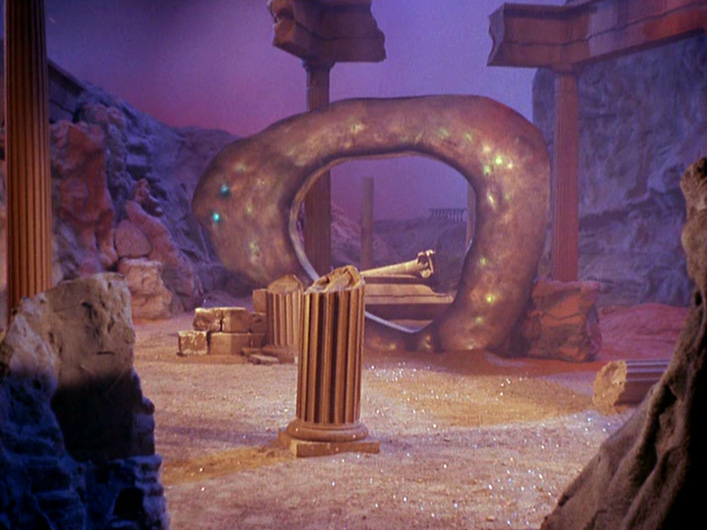
Back to my original point:  I wish to make two assertions. One, there is in fact NO Prime timeline in Star Trek.  Rather the shows are scattered about similar, even interactive timelines and causality chains created when characters from one change what’s in another.  Two, the timelines of Trek are similar and linked because of a central hub to their existence: The Guardian of Forever.  It is not just a lumpy doughnut you can time travel with.


Trek 2009 illustrates the first point very well.  When something alters the existent chain of events that defines a timeline, the timeline does not change, but rather a new divergent path is created.  I am not arguing a la Schrödinger that every decision creates a new timeline, but rather only when one is externally altered.  Evidence of these parallel timelines all already well established in Trek: the Mirror Universe being the most obvious.  The sideways universe in Voyager’s “Year of Hell” would be another, or the timeline shown in the final VOY episode where it took them 16 years to get home.  I think however there are more, a lot more and indeed from our perspective as outside observer, Star Trek: The Next Generation  (TNG) takes place over at least three different timelines, possibly more.  TOS does not take place in the same timeline as VOY or Deep Space Nine (DS9), and perhaps not even in the same timeline as The Wrath of Khan. 


A very similar set of events to the TOS we observed did precede those stories, but not the exact narrative because of altered histories.  I would argue TOS, which clearly puts The Eugenics Wars in the 1990s is somehow separate from the Khan in TWOK claiming he was on Earth “two hundred years ago.”  If we assume TOS takes place in the 2260s (and honestly, most Trek dates are conjectures based on the year 2363 given by Data in the first season of TNG) then TWOK is in the 2270s or 2280s (Kirk mentions a man he hasn’t seen in 15 years).  Two hundred years earlier puts Khan firmly in the mid to late 21st Century.  Sure, figure of speech, etc., but Khan is brilliant and dramatic.  He might use hyperbole, but I doubt he would undercut.  However, we see the VOY cast specifically go to 1996…and there is no devastating Eugenics War.  In DS9 we see them visit the 2020s and an America clearly heading toward trouble… like the trouble First Contact shows us the world recovering from in 2063.  World War Three, presumably Colonel Green’s war which ENT would indicate includes ideas of genetic purity. 

Now, look at TNG episode “Parallels” which actively shows Worf bouncing between similar yet different universes.  Some are so similar as to escape basic notice.  Some are variations so different as to drastically alter known history.  One of Worf’s main indicators (and the audience for that matter) of his dislocation is the shield hanging on the wall in his quarters.  Remember, though Worf passed through the quantum fissure on the shuttle on his way back to the Enterprise, he doesn’t start jumping realities until he is in proximity to Geordie’s VISOR.  Therefore, the Enterprise on which the episode begins is this Worf’s original ship.  When he enters the party in his quarters, there is a round shield hanging to the left of the doorway, and it and other decorations change as the shifting begins.  At the end of the episode, Worf returns—supposedly where he should be—to his quarters.  The shield is not there.  We the observer are not in the universe we started in.  
Before.
After.


TNG shifts again at least once.  In the aforementioned First Contact the Enterprise under Picard goes back and assists Zephram Cochrane against the Borg and to make the first warp flight.  As we will see in ENT this has lasting effects when a chunk of Borg sphere is found a century later in Antarctica.   I propose First Contact creates an entirely new version of the 22nd Century.  Indeed, perhaps this is why the Temporal Cold War has a front here, why the NX-01 seems to be so much more advanced than it should be, and indeed why in Trek 2009 the Kelvin—before any changes have been made by Nero—has a crew of 800.  The opening scene is not in fact in the TOS timeline but a version changed by the Enterprise-E’s presence in 2063.  Multitudes of timelines overlayed and interacting, but on some level distinct, yet close enough to provide us a fairly coherent, if not perfect narrative.  Something has to link all of this together.  The chains of events, emergent personalities (look at the success of Kirk in ANY of these timelines), are linked somewhere.  Something is affecting these timelines to make sure they stay on a basic track. Something makes sure the eddies and flow of time bring Kirk and Spock to the right place in the 1930s to find McCoy.  Something makes sure the Enterprise happens to intercept and finally assist Gary Seven in the destruction of a warhead.  Something makes sure 22nd Century Earth gets a boost of future tech before “Future Guy” starts giving tech to the Suliban.  Something makes sure Picard will be ready to fight an outbreak of anti-time, that Sisko will be drawn to the wormhole, and that old Spock will be in a cave on Delta Vega to keep yet another version of Kirk on track.  Either the entire universe(s) is based on ridiculous coincidence or time in the Star Trek narrative has a protector, a guide, a…Guardian.

The very title “Guardian of Forever” tells us it is not just a lazy gate waiting five billion years for someone to step through (“since before your sun burned hot in space…”); rather we have evidence something is holding the Treks together and there are only a few other candidates for doing so.  Q?  Perhaps, but VOY in their Q stories show us the fallibility of that being/race.  I have always kind of held out that Q was in fact the eventual evolutionary fate of the Human race, but either way we see a limited pervasiveness and interest from the Q in Federation affairs, basically the humans.  Whatever is making the Trek universe tick covers all of existence and not just Q’s pet Picard.  The Preservers?  We know they have been around a while, and may even be the humanoid progenitors of life in the Alpha Quadrant as discovered in the TNG episode “The Chase.”  The however seem far more likely to affect things on a temporal scale (get on our ship, we are taking you somewhere safe so you don’t get wiped out).  Same goes for Gary Seven’s bosses.  Far too grounded by recruiting locals from a time for a time…though there may be no reason to think there isn’t a connection. 

Further, look at the incongruities we see in the episode.  The Guardian claims no builders (I am my own ending, my own beginning).  Yet, later it tells Kirk and Spock it cannot change the speed at which it shows time because of how it was made.  This really just gives it an excuse to put Kirk where it wants to: Long enough before McCoy to fall in love with Edith Keeler.  That’s right, the Guardian is not just letting them fix time, it’s grooming James Kirk.  It is here we see Kirk cast aside the woman he loves for a greater good.  This defines who Jim Kirk is, and continues to for decades.  The Guardian needs Kirk a certain way.  The Guardian admits to Spock’s description that it is a portal to other times and dimensions.  This is why Spock, falling into the same Black Hole in 2383 doesn’t fall back as far as Nero; he won’t be able to stop the Narada on his own, or even help the Kelvin stop it.  The Guardian ensures he will be in Kirk’s life at the right moment to shape the Kirk in this new variant timeline.  It remains unchanged as the universe seemingly shifts around it after McCoy’s alterations of history.  I submit that the Guardian is the central point around which all possible Trek timelines and dimensions flow, and it takes active interest in keeping these universes in a particular shape.  Not always exactly the same, but connected and similar, perhaps as support structures within the quantum foam to keep a particular bubble, or cluster of bubbles, from popping.  The Guardian of Forever is the Star Trek universe. 

Yes, outside actors will change things (Nero, Future Guy on ENT) but in the end, the Guardian will make sure the universe is.  The Guardian abides to coin a phrase.

So, next time you’re getting caught up on some Trek, wondering why the Enterprise just to happens to end up in the 20th Century:


Or Picard happens to be at the center of a chronal paradox:


 Or Janeway happens to be able to tweak a divergent timeline out of existence by the end of the season:


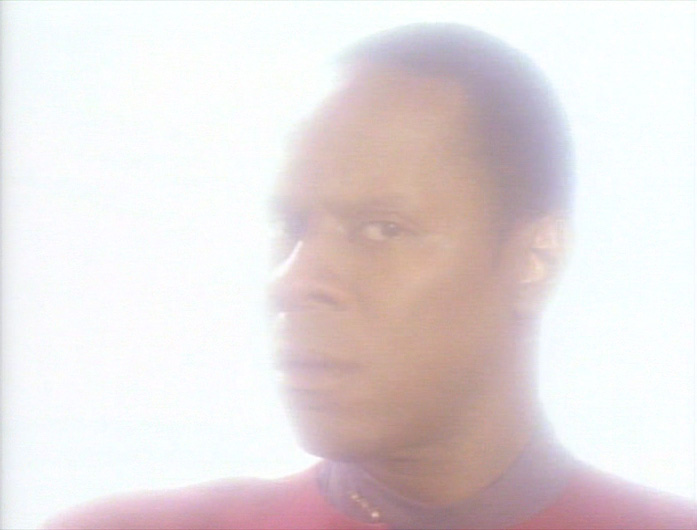
Or Sisko happens to have become commander of the station nearest the beings who may have created him:


Or Archer happens to run into a race from the 24th Century he should know nothing about:


 ...remember it is no coincidence.  The Guardian is watching.


All images property of Paramount or CBS.  Images borrowed from the awesome http://www.trekcore.com/

Friday, June 08, 2012

The Official Black Owl Review of "Prometheus."


SO YOU KNOW: SPOILERS        SPOILERS         SPOILERS (all images property 20th Century Fox)

I believe, in my life, I have seen a handful of "perfect" films.  Now, in my mind "perfect" does not necessarily correspond to "best" but they are films which present their subjects in such a way that no change could improve the way they play out.  The first perfect film that comes to mind for me is always "Raiders of the Lost Ark."  The character of Indiana Jones, the pace, the evil Nazis, the memorable moments: all of it meshes to perfection and presents an action-adventure like no other.  I also like to mention "Conan the Barbarian," the Milius version from 1982, not the 2011 version.  The movie has almost no dialogue, but the imagery, the violence, the bastardly nature of Conan are just pitch perfect as a fantasy movie.  The 2011 version really just serves to point out the greatness of the original.  Nothing would make it better.

A third "perfect" film is Ridley Scott's 1979 SF/Horror classic, "Alien."  From the everyman "space trucker" characters to the disturbingly sexual overtones of the hideous xenomorph, to the plausibility of the tech and design, "Alien" is truly perfect.

So perhaps thinking "Prometheus" would be as good was a mistake.  Don't get me wrong, "Prometheus" is a very good film, and though not as scare oriented as the original offers one truly horrific scene that made the entire theater very uncomfortable, and yet fit with the story.  There are a couple of excellent performances, and the set and shot designs are stunning.  But...  

Let me start with what doesn't work, so I can get to what does; because what does work, works wonderfully.  This film is flooded with actors, and has barely any characters.  As much as the aforementioned everyman crew of the first film made plenty of mistakes and had their share of..."special" moments, many of the actions and reactions of the characters in this film defy even the strangest Hollywood logic.  Charlie, one of the scientists whose research led to this mission seems inconsolable when "all" they find is absolute evidence of all his theories and, oh by the way, the origins of Human life on Earth.  Fifield, the punk-rock geologist (see what I did there?) who TAKES A JOB TO BOLDLY GO WHERE NO MAN HAS GONE BEFORE freaks out at the first sign of alien life... which is quite dead.  Even more bizarre, the BIOLOGIST who has the opportunity of a life time freaks out and wants to escape when he sees 2000 year-dead alien bodies, but thinks it's a good idea to pet the very alive very squirmy wormlien.  Additionally, there's a bunch of people running around who never get names, so when they get whacked, you just don't care.  Taking the time to show us those people could have been better spent investing us in the characters whom we do know; I barely sympathize with Doctor Shaw, and she's the one asking the big questions which are the crux of the film.  

There's some inconsistency with the threat as well.  There's black oil (did someone get Chris Carter's permission?) that turns worms into evil snakes, and geologists into zombies, and when ingested as only a drop makes mopey archeologists want to be burned to death.  But said oil also was used by the Engineers to infuse (through a haunting scene of self sacrifice) their DNA into life on Earth.  And when apparently channeled through a couple of human reproductive systems (including one that doesn't work) makes humans gestate Cthulhu-like babies that will later mix with an Engineer and make a proto-xenomorph (more on this later).  I appreciate that some of the ambiguity is intended, particularly on the part of The Engineers who seem intent on destroying human life having created it, but the Oil comes off as a bit Deus-Ex-Machina to me doing whatever the writers need it to do when they need it.  I also had a hard time suspending my personal disbelief that Dr. Shaw could have a Caesarian to remove a particularly violent little octo-thulhu and then sprint down alien hallways and rappel off alien ships.  Just didn't work for me.

So what does work?  A hell of a lot actually.  Although they missed some bets on these details, the big stuff is pretty damn good.  The character who works really damn well is David, who I think also provides the focal point of the big questions.  Charlie is so distraught he can't confront his creators about their purposes, yet repeatedly treats humanity's creations with disdain.  David is an outcast among his so-superior creators, while those same people seek their parents and expect answers.  Fassbender is as usual perfect in this role, and I actually found I appreciated the movie a bit more placing the story around him rather than Dr. Shaw.

The sets are truly stunning with enough visual link to "Alien" to know there's some connection, but enough questions left that you know you don't have the whole story yet.  This is NOT LV426, so how does one of the Engineers with a ship full of Xenomorph eggs get there?  How did Weyland become Weyland-Yutani?  How does Weyland-Yutani KNOW there will be an Engineer ship full of xenomorph eggs there when seemingly the first xenomorph progenitor only comes into existence on LV223 after Dr. Shaw and David leave to find the Engineer homeworld?  Why DID the Engineers seed Earth with their DNA, planning to revisit it with the Black Oil millions of years later?  How did it wipe out this base?  Why did they leave a map for us to find their secret weapon of mass destruction base?  Is the Black Oil really the next intended "upgrade" in our design?  What else will the proto-xenomorph "breed" through to become the steel-jawed Alien I crapped my pants to in 1979?

Whoa.  Obviously I stumbled into what the movie does best; it makes you think about it.  You want the answers as much as the characters did, and perhaps more than the ones who didn't even know why they were there (and I still don't know why they were there...).  It is a great movie to speculate over, and you can't help but move into real life questions about our place in the universe from there.  In that, complete success.

So yes, a very good film, with a lot to offer.  I like it, but really think it could have been more, could have been tightened up, could have had one more re-write.  I am looking forward to seeing what subsequent viewings do for me, and what little things are going on I just downright missed.  Though I am disappointed it wasn't better, it is not a disappointing film.  It's borderline great.

But not perfect.

Saturday, August 06, 2011

The Official Black Owl Review of “Rise of the Planet of the Apes.”


So, recently I have seen some pretty good movies (Thor, True Grit) and some pretty poor ones (Green Lantern), but right now I want to discuss a movie I loved, loved, loved. Lots of spoilers will follow, but I will start with a little background, and give a spoiler free review.

I was probably eight or nine the first time I saw the original Planet of the Apes. Saw it on TV with commercials, they way we watched movies pre-VHS, and must freely admit I shrieked a little in horror and despair when the (spoiler for the original here... but I don't feel too bad about spoiling a 43 year old movie) Statue of Liberty makes her appearance, and the director masterfully fades to credits with no sound but the ocean waves. Then, our local CBS affiliate started showing the TV series Saturday nights after the 10 o'clock news, and I would beg my Dad to stay up with me, and usually fall asleep before Galen, Burke, and Virdon escaped Spock's dad in a Gorilla suit. Bless my dad though; he put up with that most of the summer that year.

When we started getting TBS, various Ape movies would show up, and I was there. To this day, regardless of the fact I own them all on DVD (and the aforementioned TV series, AND the animated series, AND the Tim Burton remake), if I am flipping through the channels and an Ape movie comes on, everything else goes on standby. Even if it's Battle.

About the Marky Mark/Tim Burton version; I don't hate it. I think the Apes are extremely well presented, and the effects are good. The story's a little slowly paced, and the twist ending is nailed on so poorly and inorganically the DVD actually has an interactive feature to try to explain how that crazy crap happened... and it still really doesn't work. Trick endings are like jokes. If you have to explain them, they weren't told right the first time.

Regardless, I love the Apes movies, and with the Lincoln Memorial Ape still burned in my mind I heard they were making a new one. I was skeptical, but willing to give it a shot. Certainly concerned that all the Apes would be CGI, and that this new one would basically rehash what we saw in Conquest of the Planet of the Apes. To be objective though, the Ape origin there pushes more than a little credibility: a space virus kills all our dogs and cats, so we enslave apes who in 20 years are now wearing clothes and human sized, ready for the secret child of two future apes to lead them to an Ape-Power victory over their homo sapient masters. There's a few non-sequiturs there, and even a few inconsistencies with the other movies. Saw the first teaser, and I was mighty intrigued. Then I saw the four minute promo clip and my interested was piqued. It looked pretty damn good. And now that I have seen it?

As stated above, I loved, loved, loved Rise of the Planet of the Apes. The action is good, but this is a film with a heart and mind as well, and that what sets it above other summer movies. It is smart, providing very reasonable scientific advancements as the catalyst for Caesar's rise. Caesar as a character though provides a heart to the film, and the motion capture emotions on Andy Serkis' Caesar needs to be honored somehow, be it a Best Actor Oscar for Serkis, or one for everyone who brought Caesar to life. Yeah, I said best actor; this is Caesar's movie, and really even top billed James Franco is there only to allow us to get to Caesar. This is a choice that must have looked like a big risk to the production, but pays off in spades. The set of Ape characters with their personalities and quirks... I could watch them for hours. Caesar though, with his brilliant mind still driven by chimpanzee emotion is compelling, and compassionate. The only other performance that comes close is John Lithgow as James Franco's father suffering Alzheimer's; if I have any complaint it's that I didn't get to see these two performances interact more, but when they do it is heartbreaking gold.


I also want to point out the incredible love the makers of this film have for the original property. The film is littered with deep and arcane references to the other films, yet only once does it seem to be wedged in (and I am sure it is no spoiler to you to know that a certain line about “damn dirty apes” would be repeated), but the moment following it makes it oh so worth it. I would love to meet the writer and director, because I have no doubt we could sit down with beer and pizza watching all the Apes movies and have a great time... because they have obviously done that themselves. Little moments and images all part of the texture of the film that a new viewer can see and not be distracted by, while Ape-Heads like me can smile. Those moments serve to tie this movie to the others, and make it a very coherent prequel. I would love to go into some of the subtler ones here, but I don't want to spoil anything. Keep an eye on the news the characters watch though.

I have heard complaints that the human characters are a bit two-dimensional in this film, and in some cases this is true. Didn't bother me though; this is the Apes' movie, and they rise well. It is so nice to see a good, hard Sci-Fi movie that tells its story well. I hope it succeeds, because it is a movie which deserves to be seen. My fear is someone will then decide there MUST be a sequel, and I don't know we need that. Then again, I wasn't sure we needed this one, and I left the theater giddy. Ape fan or not, if you are looking for a good blend of action, intellect, and emotion, this is worth checking out. Hail Caesar.


Friday, February 04, 2011

Unified Field Theory: Adama squared.


It's been a while since I simply dropped into full geek mode here on Black Owl, but I've had one festering for a while in the back of my head, and I think it's time. This is my unifying theory to unite the classic Glen Larson Battlestar Galactica (henceforth “GL”version), with the modern Ron D. Moore, “greatest-TV-show-ever-made-according-to-Dan” version (RDM version). There will be spoilers for both shows, so if you haven't seen or finished either, but plan to, it may be time to turn away now. You've been warned.


First, I must establish some ground rules here. I am reluctant to include Galactica 1980 in the canon as any more than an interesting thought which met the poorest execution imaginable. Indeed, setting the arrival of the Galactica to Earth in 1980 not only puts a kink in my theory, it also contradicts the Classic Galactica episode “The Hand of God” in which the ship intercepts a transmission from the Earth Apollo 11 mission to the Moon. I freely admit science was very shaky on the original show; it was never really established whether or not the Galactica even had a faster than light drive, though lightspeed travel is mentioned on a few rare occasions. Terms like “solar system” and “galaxy” are used interchangeably. I think we have to accept that there is some form of super-luminal drive however, and further that the Galactica is still pretty far from Earth at the end of season one. G1980 claims thirty years have passed since the Cylons destroyed the colonies, putting that destruction around the Earth year 1950. Unless the first season of classic Galactica is actually twenty years long (and it obviously isn't), they could not have intercepted the Moon landing. Perhaps they are moving at relativistic speeds, thereby suffering time dilation effects, but then Baltar, during his time spent with the Cylons, would have aged at a different rate than the Colonists. Besides, the Apollo transmission itself is only moving at the speed of light, so depending on how many light-years the Galactica is from Earth at intercept, it has to be that many years after the famous Moon landing on Earth. Therefore, if the Galactica is twenty light-years from the signal's origin, it is already 1989 on Earth.

I will however give 1980 credit for introducing the first human looking Cylon, which actually ties into my theory very well. After all, this has all happened before and will all happen again.

I submit that despite the fact the RDM show follows the exploits of a particular group of survivors, there would have been more. We know the Pegasus was finding other civilian ships, and doubt they found all of them. Anders' little band of merry Pyramid players can't be the only people in the mountains on Caprica when the Cylon bombs fell. Eleven other planets had to have some survivors. Yes, many would have been herded up and out when the Cylons claimed Caprica, but humans are remarkably resilient, and it does not seem that far fetched some were waving good-bye when the Cylons left Caprica to go meet up with the escaping Colonial fleet at New Caprica (as seen in “The Plan”).

So, while Kara Thrace and William Adama are off with Gaius Baltar realizing that the Cylon god-entity is in fact...God, there are a number of poor schleps mucking about on the twelve colonies who have no idea that the machines which tried to kill them are all part of an ongoing cycle of evolution throughout the universe. All they know is what our cast knew in season one: Humanity came from Kobol to found the twelve tribes, there's a thirteenth tribe out there somewhere called Earth, and by they way, we are all a bunch of poly-theists. Now of course, they are living in the ashes of holocaust, and there are problems with radiation and the like, but there is also an essential distrust of technology, and a new dark age. While Adama is burying Roslin and choosing to swear off technology, the Capricans are kind of forced into it, but still not too happy with robots.*


We know from RDM that two things happen when the Colonists settle on Earth and scuttle the fleet: one, a surviving group of “toaster” Cylons take a Basestar and go off to find their destiny; two, Humans and Cylons mix ingraining certain things into our racial memory. Their decedents will accept their zodiac, worship their gods, and eventually, with an eerie accuracy, re-discover their technology. There's 150,000 years in which to do so.

So during that 150K, what's happening in the 12 Colonies, and what's happening with our Toaster friends?

On Caprica, and the other colonies, the human race is growing again. It's going to take time; the aforementioned radiation is going to be an issue, as is the diminished population. Humans will survive though, and eventually rebuild a civilization as the Colonies of Kobol, as they were before, but with more flowy chiffon clothing. Eventually there will even be technology, and a new fleet of Battlestars. Indeed, perhaps the cycle plays out a couple of times in this period. GL Galactica may not be the first time the Capricans rise from the ashes. For this theory to work though, we do have to accept that the Colonists have lost track of how long ago humanity left Kobol; in accordance with Genesis and the Book of Mormon (on which many original BSG concepts are based) humanity came to be on Kobol only 6000 years before GL BSG takes place, brought into existence by the Beings of Light. It doesn't seem to difficult to believe those histories will be renewed by any successive generation of Capricans, confusing events in their past, but keeping the basics the same (see our own histories and Noah, Atlantis, Gilgamesh, and the Navajo story of Turtle).

Meanwhile, the surviving Toasters who leave New Earth, return to their old stomping grounds, perhaps in an effort to trace their own origins. They return to space near Kobol and the Colonies. They evolve. They start the cycle again. Perhaps those Toasters decide they still want to become organic, but not human. In GL Galactica we find out their Cylons began as a reptilian race eventually overthrown by machines... what if the origins of those reptiles were in fact the surviving Cylons from RDM Galactica, attempting a different kind of biological evolution, but instead repeating the cycle?

The result is the same. A thousand year (yahren) war between humans on the twelve colonies, and the Cylon Empire. While you and I, human/cylon decedents ourselves, are heading toward the cycle again with little ditties like the industrial revolution, the creation of pocket calculators, and eventually computers, and Bob Dylan's “All Along the Watchtower,” it seems GL Galactica is happening, and repeating the great cycle. Perhaps as racial memory, some of us even suspect such a thing is going on:

There are those who believe that life here began out there, far across the universe, with tribes of humans who may have been the forefathers of the Egyptians, or the Toltecs, or the Mayans. Some believe that there may yet be brothers of man who even now fight to survive somewhere beyond the heavens.


There are still a few mysteries here: who exactly ARE the Beings of Light and Count Iblis? Perhaps survivors of the original Kobol or original 13th Tribe (Cylon Earth), or “Angels” not unlike Head Six and Head Baltar from RDM? (I'm a little partial to the idea that perhaps somewhere there are other copies of the Final Five, and Count Iblis is a last remaining Cavil who survived the battle at The Colony.) Are the other human worlds the GL Galactica finds (Terra) also descendants from Kobol, or left over survivors from the RDM Cylon apocalypse? Is Dirk Benedict Starbuck the messianic figure Kara Thrace was? Should we count Galactica 1980? It does feature Dr. Zee, a human/Being of Light hybrid, who may be that series' Kara; and as mentioned before, GL Cylons making human versions, starting the great cycle themselves. Then I see flying motorcycles and say 'no.'

So that's the basic idea. The two Galacticas are in the same universe, but the earlier version actually happens after the newer version. Imagine Lorne Greene's rag tag fleet arriving to our world, just as our own Cylons begin to exhibit behavior not quite so subservient... say! I smell a fanfic coming on!


*As an aside, I have heard a number of people tell me they cannot believe the surviving Colonists who make it to New Earth at the end of RDM Galactica would give up technology so easily. I submit you may be off a different opinion when your iPods commit genocide and start a four year chase across the galaxy to do nothing more than kill you. Suddenly, my favorite playlists seem a little less necessary.

Sunday, November 01, 2009

There is hope for Humanity.


At Wal-Mart today, I had to get out of the way so a twelve year old girl could look at Star Trek figures. I warned her (with every intention of being a smart ass) that Wave 2 had not arrived yet. She responded that she knew, and was looking for the short packed Uhura from Wave 1. I realized, this girl knew that of which she spoke. She then however, said Captain Pike was an idiot as she shuffled past his figure in the stack. (For the record, that's when Jennifer just walked away.) I asked what her beef with Pike was, and she went on to explain (SPOILERS AHEAD) that Pike must have been on the Kelvin, and did little more than run. I said sure, he'd written a dissertation about the Kelvin, but we didn't know he was there. "If he knew Kirk's Dad, and knew so much about the Kelvin, didn't it make sense that he was?" Dear God, she was right. I conceded and applauded her, and went on to say how it did my heart good to see ANYONE under 30 like Star Trek again. She replied, in a Great Bird of the Galaxy blessed voice:
"I was born a Trekkie."

I realized at that moment, regardless of everything wrong with the species, humanity was going to make it. We were still breeding Trekkies. Aham'd Allah!