Showing posts with label Star Trek. Show all posts

Wednesday, February 14, 2018

A Long Road, Getting from There to Here: One middle-aged Trekkie’s look at “Star Trek: Discovery.”


With the exception of a few tweets here and there, I have been mostly pretty quiet about DISCO (a nickname I love, by the way), as I have wanted to let it play out before I cast full judgement.  Looking at TNG or DS9, both had pretty lackluster first seasons before they went on to greatness. Indeed, TNG, like ENT later, found it’s stride really in the 3rd season in my opinion.  I find myself now additionally glad I waited because DISCO is not structured like any series that went before it. The story is so continuous, these 15 episodes are really structured like one long episode with a teaser and four acts.  

And, much as the pilots of previous Trek series spend the first three acts building the problem before we see our crews gel to fix it, DISCO delivers its story the same way; but in this case, that means it is in episode 13, “What’s Past is Prologue” that we get that moment when we are reminded this is a Star Trek show, and this is a crew united in great purpose.  I know people who checked out after the pilot episodes (“The Vulcan Hello” and “Battle at the Binary Stars”) as the show was too dark, didn’t feel right, and seemed to project some pretty non-Trek themes.  They were correct; but those TWO episodes are just the teaser before the credits in my model, or Sisko’s flashback to Wolf 359 in the DS9 pilot. The show continues to be dark in places after that, but indeed it is building, and when its pieces fall into place it is satisfyingly Star Trek.  But you have to watch them all.


So that non-Spoilery summary being there, I do recommend the show, and I will get into greater detail why in a moment. I am not going to discuss CBS and their model for distribution.  I think there are valid complaints about it, in particular when it would have problems streaming, or the service didn’t quite offer all that it was supposed to.  I am just here to talk about the show; and that show is very well written, delightfully well performed and produced, and despite taking its time, certainly finds itself a worthy if imperfect addition to the Star Trek universe. I would certainly hop on the Discovery for more adventures, and I hope we see them soon.

Now, let’s get straight to the biscuits; there is something old time Trekkies like me are going to have to accept in order to watch the show.  The producers, so far as I can tell now (and it is possible there will be some in-universe multiverse answer in later seasons), consider story to be canon, but not visual aesthetics.  So, when we see this complete re-design on the Klingons, the idea is just these are Klingons. When we see a Constitution Class at the end of the show and it does not look like the original Matt Jefferies design, well that’s just what they look like in this show; it’s intended to be the same ship. I know visual continuity is important to a lot of fans, and if you don’t think you can put it aside for the story, perhaps DISCO is not for you. I will admit I still struggle with seeing these Klingons as “Klingons.” I also understand that it’s the 21st Century and a new audience is not going to watch something that looks like it’s ten years older than a show produced in the mid 1960s.  

One might argue that they should not have done a prequel then. I would agree if not for the great context they manage to bring to events we thought we knew. Yes, we seem to have traded human looking Klingons suffering from the Augment Virus for Lou Gossett Jr. from “Enemy Mine,” but we gain an incredible look into Sarek’s household and his relationship with Spock that left me reeling.  We see why it seems Starfleet is so small in TOS, though it was much bigger in ENT and later in TNG. We see why Kirk and crew are so adamant about how vicious the Klingons must be in “Errand of Mercy.” In the end the benefits outweigh the lack of visual continuity, and the show does look fantastic.


Mostly.  I did spend the first few episodes wishing the Klingons felt more kinetic. Choosing to do all of their dialogue in Klingon is bold, but it made for some very slow scenes for a while.  Also, I am not very enamored of the Starships we see on the show, with the exception of the Discovery, which I love, and the Constitution Class that shows up at the end.  Oh, all right, we’re in spoiler territory: It’s the Enterprise. I like their update of the Enterprise. The Klingon ships to me look clunky and not at all predatory enough. I think I would have preferred something like the Kelvin Timeline battlecruisers (or Klingons for that matter) or an update to the great old Jefferies design closer to what they do with the Enterprise. 

Beyond that however, set design, costume design, props, makeup; all superb.  Doug Jones brings a great alien-ness to Saru, and I do have to credit Mary Chieffo for the performance she gives through layers of new Klingon makeup.  We do see a world that is based on but not beholden to a fifty year old version of the 23rd century; we see a 23rd Century that looks like a future conceived today.  That may be a tough sell for some people, but I chose to take it, and I am glad I did.

The story overall is very good with themes and character development intertwining through multiple storylines.  There are some twists, but I have to say with rare exception, I saw them all coming.  I won’t claim any rare gift, and in retrospect there were subtle clues I did miss, but the reveals of Tyler being Voq, Lorca being from the Mirror Universe, and Georgiou being Terran Emperor all seemed pretty obvious. However, each actors’ performance regarding these revelations was fantastic. In particular the way Shazad Latif transforms his demeanor and voice between Tyler and Voq was astounding. Truly great performance.  And that is saying a lot on a show full of great performances.

If I have any other gripe though, it is probably just me being a complaining old man. I think I should be able to put on any Star Trek and let my grandkids wander through the room. Network and syndicated standards and practices have kept most of Trek at that level of accessibility. Streaming allowed for some gore here that would be a little strong for my Granddaughter, and of course Cadet Tilly’s “fucking cool,” “those assholes,” and a “shit” there at the end. Except for the f-bomb, I can get past the others, but for me “fucking cool” just felt wedged in because they could. I did however really adore Tilly as a character and May Wiseman did deliver the best and most heartfelt comedy on the show. She was an absolute find by casting, and the many phases of Tilly hair did always keep me guessing! Seriously though, her ability to portray naiveté and nerves while still delivering her knowledge with a bit of brass and confidence of someone who will grow into an amazing officer, was fantastic.  Captain Tilly will one day be as badass as Captain Killy, but she’ll have the heart to go with it (more on that in a moment). 

So another little something bothering me is the death of Hugh Culber. The matter-of-fact presentation of Culber and Stamets’ marriage made up for a gaping representation hole in Star Trek, and their relationship was palpable right down to their little photon toothbrushes. I bought every minute of them as a couple, and really looked forward to the moments they shared onscreen.  It is an effective “oh shit!” moment when Tyler snaps Hugh’s neck, and when Stamets later confronts Tyler over it, I wanted to weep at how well Anthony Rapp conveys his sorrow while holding on to his own humanity in response. Producers have mentioned that Culber’s death does not just mean the standard “kill a gay guy” trope, and I hope that proves correct. I would love to see the Doctor and the Mycologist reunited, but I am not sure it’s something that can be pulled off in a plausible way. Of course, the mycelial network works in mysterious ways.  As much as I have reserved judgement on a few things until this season is done, perhaps I need to hold out  a little longer for some others. After all, ENT waited until season 4 to have their Vulcans really make sense. 

Other things I would praise include Rainn Wilson’s appearances as Harry Mudd, and the plethora of easter eggs scattered throughout the show.  But I really need to talk about Jason Isaacs as Lorca. Indeed, the more I have thought about his character and the eventual reveal of him being from the Mirror Universe, the more I have actually thought of a different TOS episode being revisited: “The Enemy Within.”

One of the points that older episode makes is that Kirk is ineffectual as a commander without the wolf inside. The compassion of the lamb must have the jaws of the wolf to back it up, but so does the predator need the feeling of mercy to temper it. That’s a fascinating statement to make 50 years ago, and honestly one that holds up. In an age where we are as divided as a society as we have ever been, it may be true that a nation of the meek cannot stand, but a nation of wolves would be monsters.  Finding the balance, the compromise is the better way forward.  Watching Discovery, and especially looking back at earlier episodes now knowing the eventual motivation of Captain Lorca, it is interesting to note that despite some horrible acts (mostly in abandoning people like Mudd and Admiral Cornwell where mercy should have been in evidence) he is a good Captain. He wants the best from his crew, he does forge them into people who will survive the war. The right actions for the wrong purposes.  It is an interesting dichotomy that certainly sets the stage for Kirk a decade later referring to himself as “a soldier” or “admit that we’re killers,” or dealing with his wolf when torn asunder from his sheep. We can say the more diplomatic Jean-Luc Picard has evolved beyond that, but we see the steel of violence in him when he needs it. Hell, Sisko punched Q. Back to Discovery, I found Lorca’s character fascinating for this reason, and Jason Isaacs really brings it in his performance. I would imagine even Mirror Lorca had a part in the growth of the future Captain Tilly, and man I’m hoping that’s a movie we get someday.

So despite some reservations (though I can’t think of a Star Trek for which I don’t have a few of those), the first season of Discovery has surprised me in how much I have come to like it. I can see where some very die hard folks won’t be able to get past the shifting aesthetics or the suddenly curvier Enterprise, but it took me a few years to realize that Star Trek was not about starships. It’s not the quality of the set, it’s the heart of the content and despite some slips and starts, the Discovery crew has the heart of Star Trek on its sleeve. I can’t ask for more than that.

Well, maybe some Kelpien soup too.


 (All images property CBS)


Friday, July 22, 2016

The Star Trek We Need Right Now; the Official Black Owl review of Star Trek Beyond.


Short non-spoiler version: drop what you’re doing and go see it right now. Okay?  Thanks.

From here on out, spoilers abound; you have been warned!


I am one of those Trekkies who actually really loved Star Trek Into Darkness.  Not at first when I was kind of “well that was pretty good” about it, but as I rewatched and saw the themes opening up, and the multilayered character motivation and allegory come to into focus behind all the kinetic action, I have to say it really grew on me.  Given that, despite the vociferous hate from other fans, I was a little worried when the sequel pulled Bob Orci as writer, director, and seemingly whatever else he was doing.  Replacing him with Simon Pegg and Doug Jung I knew would likely give us a more “traditional” Trek film.  What I did not expect was a movie that perfectly conjoined the best of the new films (now referred to as the “Kelvin Timeline”) and the best of the Original Series.

What this means is still plenty of kinetic action (indeed, I think the film takes less breaths than STID did) while having a less complex subtext, and focusing not on the accusatory allegory but the example of a  better tomorrow.  OK, there’s still some allegory there, but I’ll get to that in a minute.  Let me get the couple of things that didn’t quite work for me out of the way, and then I can dig into the many, many things that did.

The plot itself is pretty pedestrian: a mean alien wants to drop a bioweapon on a big starbase and he exploits the Enterprise to do it.  Pretty straightforward, though Krall’s origin and motivation which left me a little cold initially make more sense as the grander theme of the film unfolds, so I’ll give it that.  Many of the action sequences seem a little too familiar.  Kirk hangs off things again; the Enterprise crash and running through spinning corridors as it spirals and pitches felt strongly like STID.  Just the Enterprise getting beat up for a final time gave me a little pause, but the sequence is so visceral, and much longer than one would think as to make me be willing to accept that.  Indeed, in the process, we get this kind of nod that the Enterprise is herself a character and we’re watching her death, and that’s something I needed for this to work.


There are a couple of places where I felt a few logic gaps: Why couldn’t Edison and his crew fix and launch the Franklin with years to work with when Scotty and Jaylah alone were able to make it work?  I never did quite get the idea how much of The Swarm was manned and how much was automated.  It seems to me there was no way Krall had 80,000 troops (40,000 Swarm ships, two people each) yet every time Spock and McCoy entered one, they found a manned one.  And rather than fighting with the big air fan to blow the bioweapon out into space at the end, why couldn’t they just beam it (and Krall) out into space?

None of these are problems that ruin the experience for me, and perhaps subsequent viewings (only two so far) will reveal some of those answers for me and I was just being dense.  I admit to having fought down a rather nasty stomach virus to see it, and my gurgling belly might have obscured some dialogue.*

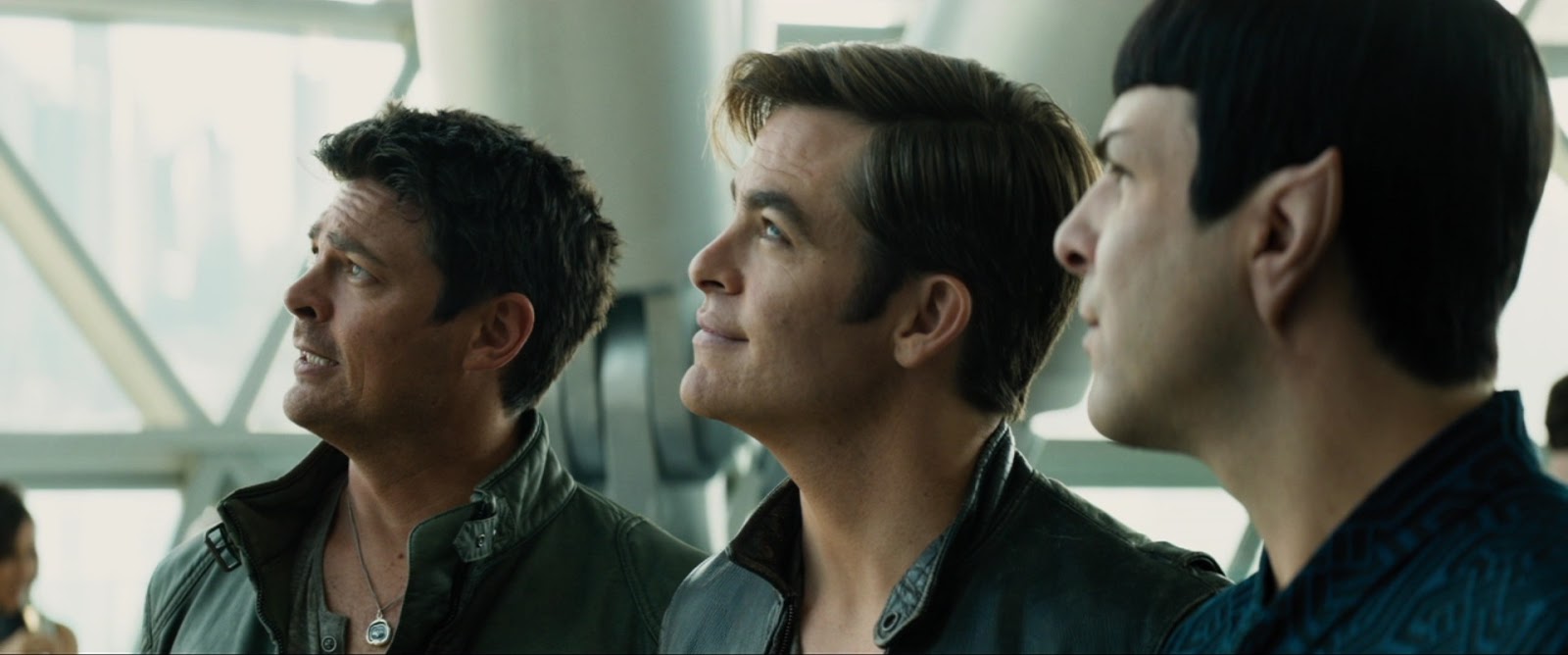
Even if not, there’s so much great Trek here, it really doesn’t matter.  We tend to forget a lot of the stories on TOS were fairly standard tales; it was the moral of the story and above all the characters that made TOS more than the sum of its parts.  This film does great things with those characters.  Everyone gets a moment to shine, and some are so deliriously perfect (looking at you Karl Urban) as to make your head spin. 

I found Chris Pine’s Kirk particularly interesting here; he is NOT the Kirk of the Prime Universe, but seems to in this case share the malaise we saw in Christopher Pike in “The Cage.”  That makes a lot of sense given this Kirk’s origin, that he might reflect Pike a little more; Pine delivers it wonderfully, and as Kirk breaks his existential ennui and emerges again ready to go boldly at the end, we buy every minute.  He gives a marvelous performance that never makes you doubt he is the Captain.

The newly introduced Jaylah character is a lot of fun.  Smart, capable, and not once sexualized.  I hope we get to see more of her in the future, or indeed, she might serve wonderfully as a spin off character if Paramount would ever bother to actually market or expand it’s film franchise (sorry, that’s a different rant).**

Again, as short as her presence in the movie is, the 1701 gives us some sleeker lines, and some painful moments that made my stomach hurt for her (maybe it was the virus): the severed nacelles, the cut throat, the helpless saucer burning in.  But, that moment when in her final motion she gets her revenge on Kalara, the alien who betrayed them all and led them into the trap in the nebula, that moment was special.  Kirk said she had a few tricks left, and indeed she did.


The trick of bringing in the real world death of Leonard Nimoy by making Prime Spock’s death organic to the arc for young Spock was inspired.  Not only does this film give us that acknowledgement, they manage to give us that image as a nod to all of the classic crew from “The Final Frontier” and I will admit, my eyes filled with tears both viewings.  Such a nice way to honor the originals, living or dead.  I hope they do as well honoring Anton Yelchin in the next one.

Other callouts to earlier Trek included a reference to Apollo from “Who Mourns for Adonis?”; actually seeing a universal translator work the way it would have to; and an again completely organic reintroduction of the Beastie  Boys’ song “Sabotage.”  Look, I don’t care if you like it or not, but I love the tie between Kirk and the Beasties.  No one batted an eye at “A Tale of Two Cities” or all the Shakespeare that shows up throughout TOS (and a nice Bard-drop in here as well!); 300 years from now, our culture will be as classic to them as Dickens.  I like that.  Also, the use of “Sabotage” is so utterly perfect on every level, thematically right through to the stunning visuals accompanying it.  I grinned like an idiot the whole sequence.

Speaking of the visuals, just wow.  From the Enterprise’s new warp effect and fascinating angles from which to shoot her, to the simply stunning concept, design, and appearance of Yorktown station, this movie just looks beautiful.  If someone doesn’t get an Oscar for effects or production design, there’s a real problem.  Yorktown alone could be the setting of a thousand sci fi stories.  Rumor has it they designed 50 new aliens for the 50th anniversary; it shows.

Here ends the basic movie review.  However, I have something I really want to talk about here.  I mentioned it took me subsequent viewings to appreciate Into Darkness more, and I found my second viewing of Beyond gave me the theme I didn’t really think was there the first time.  I could be wrong, maybe very little of this was intended by the writers, but I’m about to argue why Beyond—though a good but not the best Star Trek movie—may be the most important movie of the year.

The theme of unity and Humanity pulling together with the aliens of the Galaxy to form the Federation, and why that is a good thing is obvious.  Scotty’s grandmother’s aphorism about a twig in a bundle; the calls for unity; how team and family will win the day.  We see diversity in all those aliens, beings of all genders, and finally the subtle inserted husband for Hikaru Sulu which works so well.  The villain Krall argues against unity, feeling there must be strife and conflict in order to grow.  He can’t get over the wars he once fought on behalf of humanity and now has become a monster wielding ancient alien technology to bring darkness back into the Federation’s light.  I was initially a little “meh” about yet another rogue Starfleet Captain, but I began to think about the nature of this one.  A soldier who could not accept peace, was willing to employ the tools of others, but never join or enlist them, just to force others, to do his bidding.  He felt he had been wronged, and could not let go, and was scared of what an open future meant. 

That establishes him as the same type of bad guy as Admiral Marcus from STID.   STID is, let’s face it, a 9/11 movie.  It’s about a Democracy losing its way and employing the techniques of terrorists out of fear in the name of safety.  Beyond picks up with Kirk’s speech from the end of that and declares that we don’t have to feel that angst anymore, that we can—together—move on toward the future.

The United States has been in a state of angst over the events in 2001 for 15 years.  Can you name a blockbuster movie in the last decade that hasn’t dropped a building (or dozens, Zach Snyder) for effect?


Star Trek Beyond is declaring an end to the post-9/11 era.  It’s telling us it is time to stop being ruled by our fear and pain, and move forward.  The lighting in the movie goes from dark rooms and displays to the twilight greys on the Franklin, to a final confrontation in the light (yet the villain vanishes away in the darkness he cannot escape).  We are shown that unity is humanity’s strength as each member of the Enterprise crew brings their specific talent to the table to save the day; not homogenous, but together and celebrating their differences.  The movie talks about “adventure” and “fun” and getting past all the darkness to reach out because “there is nothing unknown; just that which is temporarily hidden.”

There’s even a scene where three aircraft are speeding toward buildings full of people, and our heroes in the USS Franklin physically interpose themselves in the path to keep it from happening.  This is not a movie where buildings fall to tap hidden fear.  This is a movie where heroes save the day, not with ease, but with cooperative will and unified just cause.

The movie is a romp, a joyride, one that does not ignore the dangers in the world, but tells us there’s a better way to confront them than with fear and darkness.  It’s the antithesis to all those dark, angst ridden blockbusters that have become so normalized.  This movie is happy, this movie takes us from the shadows to the light, this movie dares us to do better.

This is a movie that wants us to move past all our angst; and that’s exactly what I—what we all—needed right now.  With all the hate and vitriol in news and entertainment, Star Trek Beyond challenges us to be more and sets the example as to how.

As good as it is a Trek movie, Beyond is so much more important to who we are as a people right now, as TOS was a fairly entertaining space show in the 60’s that proved to be more than the sum of its parts when we needed it then. 

We need more like this; we need more movies that encourage us to go Beyond.


*Indeed! Subsequent viewings did point out to me that only Krall and two minions were actually beings (and for that matter the survivors of the Franklin) and all of the drones and their pilots were automated.  Makes me almost wonder if they had Ruk down there somewhere.

**Not even a novelization? Really?


All images property of Paramount Pictures, no infringement is intended.

Saturday, December 13, 2014

The Seattle Star Trek Convention 2014

Sporting the NX-01 Cover-all; don't be jealous.

This weekend I went to my first pure Star Trek convention since 2005.  I’ve hit a few ComiCons of various size in that time, but not a good old Trek convention in a while.  So how was it?

At first I was a little worried: it seemed so small.  Despite it having a really stellar guest list, the vendor room could not have had more than a dozen vendors.  It was in Bellvue and not downtown Seattle, so a smaller venue.  There were really only three rooms at the center in use.


And yet, this was one of my best con experiences in years.


While walking through the admittedly small vendor room, someone called out, “now that’s an outfit I know!”  It was Anthony Montgomery. 

I was apparently eating an invisible apple.
We had a long chat about his new comic (Miles Away, as see above), and I got him to sign my “Star Trek: Star Charts” map of the NX-01’s first year.  He also made sure I was following him on Twitter @MrAMontgomery.  Ha!  I already was. Then he shows the book to the guy at the table next to him and it’s a surprise guest: Herbert Jefferson, the original Boomer from Battlestar Galactica.  Though non-Trek, he was a welcome surprise guest!


I expected a quick chat and then an autograph, but on and off throughout the day Jennifer and I spent about an hour talking to Herb about various programs he supports to help Veterans.  It came up that I do career counseling for people getting out of the Military, and had myself just retired, and we were off.  Let me quickly pitch a group he is working with, iava.org.  Great initiatives to support Vets and their families and lots of Congressional lobbying, please take a moment and check them out.  He also showed me pictures of him with  Congressional Medal of Honor recipient George Sakato (and shared some of Mr. Sakato’s great stories!) and with the original Red Tails, some of the Tuskegee Airmen.  All through the day we saw Herb, and he was a delight each time.

Popping into the presentations, we caught Jeri Ryan.  As you all may know, Voyager is not my favorite of the Treks, but Ms. Ryan proved to be very entertaining and engaging and someone who was obviously there for the fans.  It was a real pleasure to listen to her, and frankly, television does not do her justice. 

Then came John Billingsley, Star Trek: Enterprise’s Doctor Phlox.  The man was a mile a minute laugh riot whose answers to fans’ questions were nearly stream of consciousness and utterly hilarious.  He had apparently hosted karaoke the night before and I was sorry I had missed it.

This is him and my wife's thumb.


Of course there were the fans.  More than a few cosplayers, but all and all a different crowd that a comic or pop-culture convention.  It reminded me that despite Trek’s great success over the years, the Trekkie can still be a bit of a minority in the now very broad world of fandom.  These fans seemed more matter of fact than the crowds I see at the big shows.  There was not the “I’m here to show you how much I love this thing” feel, but rather a “isn’t it cool we’re all here to love it together.”  I saw cosplayers from every Trek from TOS to AOS (though I think I may have been the only ST:E outfit), and it was a relaxed and intimate atmosphere.  Just a great experience. 


The geek world has become so accepted in recent years, but maybe it lost something in becoming so mainstream.  There may be a sense of camaraderie we’ve lost along the way.

This con though, it was there.  It was family, it was close, it was sharing.


It was why I go to cons in the first place.  I hope I can find more shows like this one.
The amazingly fortunate author with his incredibly tolerant wife.

Saturday, December 07, 2013

Time travel may change me, but I can't change time travel.


This has been a year where a lot of my online presence (which I typically really enjoy) has been oriented toward Star Trek.  (How's that different…shush.)  I have an ongoing fan fic on Tumblr for those days when I get five extra minutes to write.  I vociferously defended various aspects of the film "Star Trek Into Darkness."  I've chatted with friends about various series, films, and books set in the Trek universe(s).  

While doing this, I've realized that my view point on a few things has changed since I did my last generalized overview of my Trek fandom.  Age and perspective change things.  Primarily, I looked at the way a lot of Trek fans generally reacted to STID, or ST: Enterprise, or fill in the blank and realized I was contributing to the crowd saying negative things as if they were facts and not opinions.  I was criticizing fans of some Treks for even having the audacity to like those Treks like it was important that everyone saw the franchise the same way I did.  

Honestly, I realize now, that's bullshit.

I do think Trek, like a great literary work, goes beyond its original purpose of entertainment to provide food for thought and societal commentary.  That's a good thing.  Somewhere along the line I got more concerned with whether or not the Voyager could carry all those shuttlecraft, or how big the Defiant really was, or when the Romulans first developed cloaking devices than whether or not I was being entertained with good characters and stories.  Sure, I appreciate consistency in collected large scale narratives, but in the end the fact the Delta Flyer would not fit in the shuttle bay on Voyager wasn't really the problem I had with Voyager, it was the characters.  

But I also had friends, people whom I enjoyed talking Trek with that really liked Voyager, and those characters spoke to them.  Why the hell was I begrudging that? Why was I, of all people, telling people they shouldn't like Star Trek?

Maybe I only had this epiphany because I ended up on the other side of the argument a couple of times.  I, in the end, really enjoyed Enterprise, in spite of its continuity errors.  I liked those characters, I loved the look of the show, and though there are bummer episodes, I really liked the overall plotlines and when it was good it was very good.  It reminded me of another show that to be honest was occasionally really, really bad but in the end was more than the sum of its parts.

Star Trek.  Not the genre, the show, normally now referred to as "TOS" or "The Original Series."  This is going to sound harsh to some fellow Trekkies: It isn't perfect.  Also, a lot of what you remember about it wasn't actually in the show.  It is however fucking wonderful.  It deserves to be celebrated and receiving sequels fifty years later.  But it never let the need to have a moral get in the way of a kick ass SF yarn.  In fact, it usually erred toward the kick-ass.  As much as it showed societal progress in the next 300 years (or 200, or 700, or 500 depending on the episode) it didn't shy away from humanity's weaknesses either, and in the end its main goal, the reason d'être for the show was to entertain.  Even when that meant deciding a matriarchal society should figure out how equal rights for men work through "cuddling."

Here's what TOS did and did right, and perhaps some of the follow on series (and certainly fans) have forgotten.  Story diversity.  Some TOS episodes were just plain comedy.  Some were action adventure.  Some were tragedies.  Some where honestly trippy fantasy ignoring science altogether.  And that was OK, because the characters held it all together.  The tech was as capable, or incapable, or as magic-like as the writer wanted.  There's no scientific explanation for a transporter splitting Kirk into good Kirk and bad Kirk.  There's no attempt to reconcile the fact there's a time portal on Forever World.  Completely human-like robots?  Yep.  Living rocks.  No issues.

Spock's Brain.

Story diversity.  What that means is when DS9 wants to show a war, OK, let's see how that plays in the Trek universe.  When Voyager wants to come home instead of go further, well fine.  When JJ Abrams wants to do quick cuts and fast action to tell his story, OK.  Do it.  If I don't like it, I won't watch that one, but neither should I begrudge those who do, or differentiate between the titles "Trekker " or "Trekkie" to determine who are REAL fans.  Who the hell am I to tell you what you should or should not be a fan of?  I will be happy to tell you why I didn't like certain interpretations, or why I do like others; I have no reason to tell you are right or wrong in your opinions because in the end we both like Star Trek, and that's cool.  

Voyager's your favorite?  Let's discuss why.  Maybe you can't point out something I missed.

You only like the Abrams films?  Let's discuss why, and maybe I can find you some old stuff to enhance how much you like them.

You don't like Enterprise?  Let's discuss why the things you dislike work for me, and maybe you can look in a new light.

We're fans.  We should be helping that thing we love grow, and by the great bird, there's 800 hours of Trek out there, surely there's a little something for everyone.  There's some problems out there with any particular show.  Everyone should measure for themselves how those problems and the positive balance, and as I have seen online, promote what you love instead of bashing what you hate.


In the end anything that keeps Trek alive is a good thing, even if I don't like the size of their shuttle bay.