Showing posts with label movies. Show all posts

Saturday, December 22, 2018

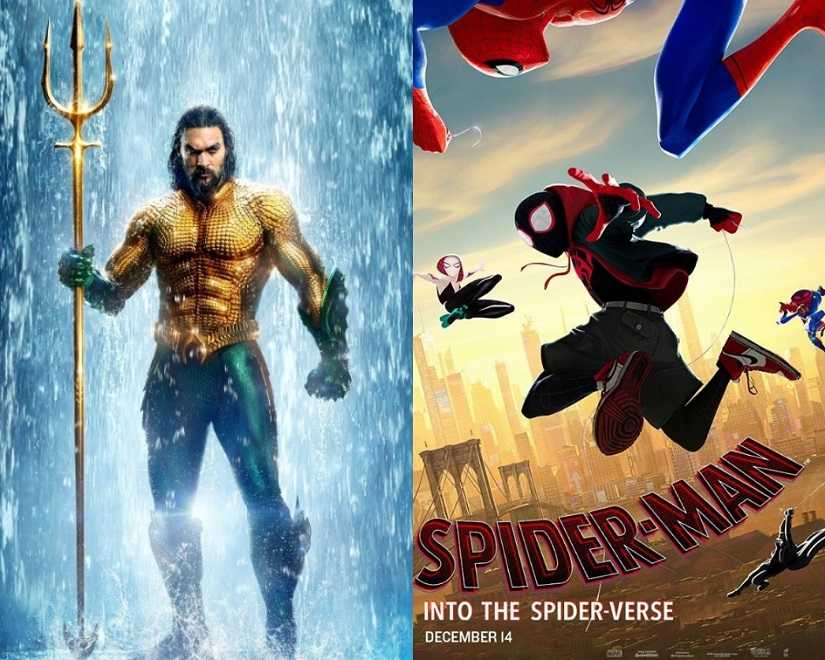
It’s about character: the two-for-one official Black Owl review of “Spider-Man: Into the Spiderverse” and “Aquaman.”


December has been an uncharacteristically busy month for superhero films and I as I have seen three in the last three weeks! I am not going to get into a review of ‘Once Upon a Deadpool’ here, but to be fair many of the things I have to say about ‘Aquaman’ and ‘Into the Spiderverse’ actually do apply. 

Sorry Wade; next time.

These movies all work because of two things: One, they absolutely present the character as the character was intended; Two, they are in no way ashamed of their comic book roots, understanding exactly what makes such story telling great in the first place. Potential spoilers from here on out.

‘Spiderverse’ leans so far into it’s comic roots, the production actually created new methods of animation to present the visuals on screen like they might appear in four-color newsprint. I was occasionally distracted by this when color wouldn’t always line up with the line work, something that rarely detracts on a printed page, but seems to be more like a blur when it motion.

Is that Kirby Crackle? Yes, yes it is.
That is however my sole complaint about what may be one of the best written superhero movies our current Golden-Age of superhero movies have given us. We meet Miles Morales, a teenager whose cop dad and medical-professional mom kind of set him up to be a person who has to help. The awkwardness of teenage years though often get in his way, and there is that cool Uncle (who may be up to no good…very up to no good) he’d rather hang out with. Add to this the bite from a genetically altered spider, and you have a prime, modern reimagining of the 1960s version of the Peter Parker story. A good movie would just give us that; this GREAT film however is still leaning into that source material.

We see the Kingpin (and the stylized version of the character is both simple and dramatically sinister) wants to reach into another universe to recover love and family lost. In the process, he manages to kill the Spider-Man Miles knows, (voiced with aplomb by Chris Pine; stick around to the end of the credits to hear a sample of his Christmas album, “Spidey-Bells”) and bring several flavors of Spider-Hero into this world.  Miles collides with all of them on his hero’s journey, while discovering his own family in a way he had not thought possible. 

Pictured Center: Guy I can understand.

All of the character work here is great, as each Spidey has to deal with their own tragedy that led them to the suit. Spider-Woman (popularly called Spider-Gwen in fandom) is given a great role here, but perhaps I most commiserate with the middle-aged Peter Parker from Earth 616. A few too many pizzas, a little too much letting ‘work’ get in the way of his relationship with Mary Jane. He’s the smart-ass Spidey we all knew, but with 25 years of baggage, and as all of the Spider-folk here, he is a perfect distillation of his character, filtered into our modern world.

And I haven’t even talked about Peter Porker, the Spectacular Spider-Ham yet.

We never do really know why his hand is wet.
We walk out with an incredibly human story where we sympathize and empathize and can see ourselves up on that screen with a Spidey-flavor for all viewers.  The live-action Spider-Man films have been all up and down the quality spectrum, with some pretty good ones out there, but I think I have to say ‘Spiderverse’ is the best foray into the Spider-world we have gotten yet.

‘Aquaman’ does the exact opposite and takes a man, making him more than human. And that’s exactly how it should be. The difference in these movies perfectly illustrates to me what the difference was between classic Marvel comics and classic DC comics. Marvel gives you characters who are YOU in extraordinary circumstances.  I identify with Peter trying to do the right thing and stay out of trouble with Aunt May.  I identify with Bruce Banner unable to control his anger and suffering the terrible consequences thereof. I identify with Tony Stark, his arrogance, and his flaws, as he still has to get it together and do the right thing. DC on the other hand gives us gods, archetypes to which we aspire. Superman as the archetype of hope. Batman as the archetype of justice.  Flash as the archetype of kindness. Wonder Woman as the archetype of peace. Aquaman as the archetype of a king.

Marvel heroes to identify with, DC heroes to aspire to; that’s what drives the readers’ preference. Marvel movies figured this out early and have ten years of success. I have felt for years the DCEU mistook those human factors for why the Marvel movies worked and tried to emulate that. Hence, we get a depressed Superman, troubled by his place as a hero. A Batman who has given in to human foible and left behind justice for vengeance, killing indiscriminately.  Wonder Woman in BvS, who no longer works for peace, but just roams the world mourning Steve Trevor and WWI.

Thankfully, the movie ‘Wonder Woman’ broke this pattern, and gave us Diana as the archetype again. Luckily, ‘Aquaman’ does the same thing, calling on its source material, and recognizing those old DC comics were the mythology of the modern world.

As I understand, this picture will quench anyone's thirst.
Not everyone will appreciate that about ‘Aquaman.’ The film’s story follows the old Joseph Campbell “hero’s journey” almost slavishly, taking Arthur Curry from the call, to the ordeal, to the black moment, to the descent and resurrection, etc. Anyone who has studied mythology through this lens will find no surprises in this story. For me however, that is exactly how an archetype should be built, and the strength of the movie lies in getting this pattern right.

Along the way, we get some very corny dialogue, and some of the most over-the-top production design you are likely to see. From weaponized sharks to Lovecraftian horrors of the Trenches below the sea, everything is cranked up to eleven.

And that’s EXACTLY the bold, outrageous, mythology-level storytelling I want from DC. Arthur is a boorish man-child who goes through all the trials to become a God-King; the fulfillment of prophecy and destiny; precisely the origin story a King of Atlantis deserves.

I would not mind a spin-off.
Along the way we do get some good updates. Mera is a delight, and the agent of Arthur’s salvation more than once. The villains, Ocean Master and Black Manta, do have a point, allowing us to sympathize a bit with their motivations if not their actions. The re-imagining of the undersea kingdom is stunning, and would have been impossible to render on screen just a few years ago.  Each scene that takes place underwater actually feels like you are underwater.

I would not mind a spin-off.
Though I do have to admit there was a moment I hoped a certain character would sing “Shiny” from the ‘Moana’ soundtrack; Tamatoa, is that you?
Aquaman Spoiler out of context.

So in the end we get two movies that are completely different in tone, but each work for this long time comic fan because they both completely understand, accept, and rejoice in their source material.  I hope it’s a lesson that Warner Brothers takes to heart, and in the future they continue to give us Deities in capes to whom we can aspire, while Marvel (and apparently now Sony too) shows us how we normal folks can find ways to be super too. ‘Aquaman’ and “Spider-Man: Into the Spiderverse” hitting all together like this has made up for my lack of a Star Wars movie this holiday season.


And you, Wade. And you.

Friday, May 25, 2018

A Cup of Star Wars: The Official Black Owl Review of "Solo: A Star Wars Story"


I will give you a quick spoiler free bit here before I dig into the weeds.  Solo is a delightfully entertaining film full of nostalgia, fan service, some deep dives into the old Expanded Universe, and a pastiche of genres including heist, film noir, western, and even a little cyberpunk. The supporting characters are mostly a delight, and it manages to both give some surprises and pretty much be exactly what you hoped for. It is not flawless, but it is well worth your time if you are even a casual Star Wars fan, and I would imagine stands on its own pretty well as a space romp.  Assuming anyone out there who likes space romps could be unfamiliar with Star Wars.

SPOILERS BEGIN!

The thing that most worried me about Solo was something that it turns out was the least problematic: the recasting of Han Solo. I was not familiar with Alden Ehrenreich’s previous work, but he manages to capture all the cocksure swagger we need to see in a young Han (who is given his last name by an Imperial recruiter when Han tells him he has no family) with enough of an echo of Harrison Ford to be convincing, but no so much as to come off like parody. The interaction between Han and Chewbacca (particularly an early conversation in Shyiiwook) is a delight throughout.  Ehrenreich and Joonas Suotamo (who steps into Peter Mayew’s enormous shoes) bring their characters to life wonderfully, and I never doubted this was Han and Chewie, right down to the replicated scar on Alden's chin. 

Donald Glover also does a very credible job giving us a legacy role, and he’s just one Colt 45 away from being a young Billy Dee Williams; suave, shifty, and notorious, Lando is also a pleasure.


New characters also get their best feet forward, particularly with Woody Harrelson’s Tobias Beckett and Phoebe Waller-Bridge’s L3-37. Both help us expand the Star Wars universe a little further.  There’s nothing wrong with Emilia Clarke’s performance; Qi’ra was just hard to connect with for me, though that is entirely in line with the character (and the eventual reveal of her true loyalties), and in no way Ms. Clarke’s fault. 


The big surprise character moment for me was actually Enfys Nest. Initially presented as a marauding pirate with her “Cloud Riders,” the Mad Max influence is evident (which in my mind called me back to the “Phasma” novel and her home world of Parnassas…will there be a connection?), when the warrior removes her mask to reveal a woman who can’t be more than 20 I gasped audibly. When it turns out she is actually intending to fund a nascent Rebellion against the Imperial system (further evidenced by the appearance of one of the Two-Tubes brothers who will later work with Saw Gerrera in Rogue One) I cheered. Sure, a Glover as Lando sequel would be great: but I will take Enfys Nest: A Star Wars Storyany day of the week. The unmasked Erin Kellyman completely holds her own on screen, and given her character’s surprise connection to the early Rebels, I would be quite curious to see how Enfys relates to Bail Organa, Mon Mothma, or even later Saw Gerrera. She is now on top of my spin off wishlists.

The plot moves at a good clip with plenty of action, and the type of theme resonance we should get in a Star Wars film. It’s a good look at the underbelly of the Empire that has been the purview of the cartoon and ancillary materials until now, and it was nice to see on the big screen. As much as I lamented not treating Star Wars like the big winter event it has been the last three years, this is a summer movie, and came out right when I needed it.

So, what’s wrong with it? Some of the cuts for me felt odd from a technical standpoint, almost like Ron Howard had to work with footage from the previous directors and try to make it fit. There are a couple of scenes that jarred me when the camera switched angles and forced me to reorient to see what I was looking at. A less minor quibble I have though is the waste of three great characters.

Early on we meet Thandie Newton’s Val, and John Favreau’s Rio who are part of Beckett’s crew, and Val is romantically involved with Tobias. More importantly, she’s a fantastically competent character both charming and dangerous who we get comfortable with rather quickly…and then has to blow herself up. Rio is very well written, providing some good comedic timing while every line reveals a trait about his character…so he can be shot in the back after about 10 minutes of screen time. 

It doesn’t stop there, the delightfully liberated L3-37, who is a champion of droid rights and quirky as well dies sadly in Lando’s arms after about 20 minutes of screen time. She has this great scene with Qi’ra where the droid says life with Lando is awkward because he’s in love with her, and we chalk that up to her odd personality, but when she’s in danger, it really does seem Lando has romantic feelings toward her. That’s something I want to see explored, I wanted to see all of these characters explored some more, but alas they are gone. I am not saying we need a deathless movie, but it was jarring to lose them before they were fully explored, and it left me with the wrong kind of “wanting more.”

Beyond all of that however, this is a really entertaining piece of Star Wars that I would like to think will not be subject to the “Not What I Wanted” gripes of those who disliked The Last Jedi. This one is ripped right out of the lore, steeped in Lucas EU, and by the Force even features a reference to Lando Calrissian and the Mindharp of Sharu. I felt like we were about to be treated to Jaxxon from Marvel Comics any minute.

You say his name, he appears.
So, a really fun addition, though by no means a melodramatic blockbuster. Very interested though to see where some ideas brought to the fore here (Maul and Qi’ra???) are going. I’ll definitely hit the theater at least once more to take this in and look forward to seeing it at home on blu-ray.

Hopefully right around the time they announce Enfys Nest: A Star Wars Story.


(all images property of Disney and Lucasfilm)

Sunday, September 24, 2017

MOTHER!


I probably should wait a few days before writing this, as this is a movie that will be waking me up in the middle of the night for months as my subconscious unravels the deeper layers of imagery and meaning.  It’s a Rorschach Test of a movie that allows different people looking at it from different perspectives to see different things.  If you’re walking in here expecting the haunted house story the trailer wanted to feed you, you are going to be sorely disappointed.  If you walk in with zero expectations and allow the movie to teach you its rules as it goes, you might find one of the most meaningful cinematic experiences you’ve ever encountered.  When it finished, Jennifer and I sat in rapt silence, wrapping our heads around what we had just seen, interpreting it the way one might look at an abstract painting or sculpture.  A guy in the back of the theater just shouted “that’s bullshit!” and went on with his day.

You get from it what you take into it I suppose.

So, I’m going to talk about the movie, I promise, and I am going to talk about what I got from the film itself.  I have to say, what I pulled from the film is apparently not what was intended by Darren Aronofsky, which you can find elsewhere if you want to read (I’m not going to do your Googling for you).  There are other opinions as well, but I will tell you up front: this movie is not for everyone.  It is often surreal, it is at times brutal, there are horrific moments that though not overtly gory are remarkably tense and there’s a direct implication of one of the most devastatingly awful things I have ever seen in a film.  Though the film follows it’s own logic, there are things that don’t quite make sense when you pull them out of the movie and look at them in the real world.  It is less a narrative than an allegory.

I am not trying to imply that someone who liked it is smarter than someone who didn’t, or that anyone who didn’t like it just didn’t “get it.”  (Though I have no doubt those people are out there.)  This movie does not give a damn whether you like it or not, and you could flow completely with the story elements and the allegory and still hate how it made you feel and therefore the movie.  As Jennifer and I wandered slightly zombie-like through a store afterward, I made the statement, “there are a lot of men who are going to hate that movie, and maybe not know why they hated it.”  This movie is black licorice: you hate it or you love it, but if you love it, it opens your world to absinthe.  See the odd metaphor I used there?  Get used to it before you go see “Mother!” 

So, now that I am 500 words in and still haven’t actually discussed the movie itself, I suppose I should.  Spoiler warning, but honestly, I’m not sure its necessary.  This movie is far more than its plot points, as atmosphere, performance, and inference are every bit as important to the experience as its relatively simple story.  The framework for the movie is a young woman, played by Jennifer Lawrence in a standout performance among standout performances, married to an older poet, played with dripping condescension by Javier Bardem.  The poet has been unable to write for some time, so he and his wife have settled into his former home which was previously destroyed by fire.  She is rebuilding the house herself while he sits in his study, not writing, but entranced by a strange gem that he later mentions was found in the rubble of the house after the fire.  One evening, there is a knock at the door, and Ed Harris arrives; a man who thought the house was actually a bed and breakfast.  Bardem’s poet insists Harris stay the night, despite Jennifer Lawrence’s misgivings, and this all gives way to a sequence of events that will start with more unexpected guests, and then wind through murder, abandonment, hero worship, riots, war, and an apocalyptic reset of the entire world they inhabit.   

Got that?  Yeah, exactly.

So, here’s what I got from the film, and promise you your results may vary if you work up the courage to see the movie.  To me, Lawrence represented the role women play in 10,000 years of human society.  She nurtures, she preserves, she restores, she becomes a mother.  She provides advice, she helps celebrate victories, she tries to help us minimize our defeats.

Everyone else in the film are the assholes who mistreat her for it.  Be it the husband who takes what she has done for granted, and can’t understand why she’s upset when he does not consult her, or did not give her the first reading of his completed work despite all her support, or who is so caught up in the adulation of others he doesn’t care to notice how much she has done to facilitate what he has created, that indeed he would be nowhere without her.  Or maybe it’s the older woman (played by Michelle Pfeiffer), who is ready to discount her experience and encourage her to rely only on her sexuality to get the attention of the man in her life.  To stay self-medicated and stop trying to build something for herself, or participate in the creative process.  How about the man who arrives, in her house, and insists she should hook up with him.  And when she doesn’t want to, when she doesn’t share her number, calls her an “arrogant cunt” and dismisses her like trash.  Or perhaps it’s the people who are perfectly happy to destroy what she has built as if it has no value because it came from a woman, and dismiss her telling them that a particular piece of architecture is not finished and will not hold.  And of course it is the society represented by the mob that will take her newborn and literally cannibalize it because they need to consume anything she has made, and then beat her savagely when she tries to resist them and maintain her agency.

Over and over I saw the allegorical examination of how society “mansplains” over women experts, or takes for granted that a women has to be sexual when we demand it, and a mother when we demand it, and her agency be damned, she should be more appreciative that she even HAS a man to take care of her.  The Poet simply baffled that she wouldn’t want to see his wishes come true at the expense of all she has done, because he has never noticed her actual struggle to make it all so. 
Aronofsky and crew have called 10,000 years of Patriarchy to task in this film, and that’s the type of message and delivery that’s going to make a thousand Dudebros go, “that’s bullshit!” and not want to see themselves in the Bardem character, or as one of the mass of people who rely on her, yet is happy to use up and marginalize the women of our society.  They may not even be consciously aware of why they feel indicted, but it will make them dismiss the film.  That won't be why everyone who dislikes it dislikes it, but more than I few I wager.


There are horror elements and suspense in this film.  In a country where one out of every five women will be sexually assaulted in their lifetime, half of those before the age of 18; where women are subjected to verbal abuse or ignored in work settings be benefit of their gender; where women can spend 20 years raising children, managing a budget, keeping a household going…and be dismissed as “just a housewife” and have nothing to put on a resume when they have decided to get out of their empty nest and into the world; where three women are murdered EVERY DAY in the US, and one of those three will be murdered by someone with whom they trusted enough to be intimate.  Hell yes there are horror elements in this film, because that is all horrific.  And that’s not even looking at other countries where women are not allowed to read, or after being told they must submit to a man’s will are then considered “unclean” and subject to being killed by their family to uphold “honor.”  Yes a movie illustrating what the world does to women is a horror movie, because how else do you tell it?

Yeah dude, I know.  YOU aren’t a rapist.  YOU don’t beat your partner.  YOU  don’t kill women who reject you in a bar.  But is your first thought when you hear about a rape, “well what was she wearing?” or “well what was she doing there?”  Do you notice how much more often men interrupt women during conversation than they do other men?  Or how much more willing men are to encroach on personal space of a woman versus another man?  You ever tell that joke about “what do you tell a women with two black eyes?  Nothing, she obviously didn’t listen the first two times.”  Ha ha, funny.  Hell, I’ve told that joke myself because it’s just a joke.

Until it isn’t.

Anyway, getting back to “Mother!” Again, other people got other things from it, and there are certainly plenty of metaphorical elements to support some of the “Mother = Earth, Poet = God, the Man and Woman = Adam and Eve” interpretations I see out there. Regardless, the performances from everyone involved are nuanced and stunning.  The photography is claustrophobic and breathtaking.  The emotions are discomforting and horrifying.  I love this film, my wife loved this film; most people are going to hate it,  either for what it says to them, or what they don’t want to hear from it, or because it does not deliver a “normal” experience.  It most certainly, regardless of your interpretation, does not do that.

I say judge for yourself, but if you’re not up for challenging cinema, you may want to let this one go by.  “Mother!” is not for the standard audience, and certainly not for the timid.


Tuesday, July 18, 2017

Let My Sequels Go! The Official Black Owl Review of "War for the Planet of the Apes."

Spoiler free for two paragraphs!
I will not rehash here my love of this franchise, all the way back to Pierre Boulle's book that was originally translated as "Monkey Planet," but more artfully as "Planet of the Apes."  You can read my review of the first of these modern films here and get my whole simian love affair leading into "Rise of the Planet of the Apes."  

Somehow, I never reviewed "Dawn of the Planet of the Apes," and I regret the oversight.  Let me assure you I found it as engaging and intelligent as "Rise" and again just as sad in its own way.  It leaves the idea that war is on its way at the end, and I was both eager to see where a third film would go, and anxious that like so many modern films we would stumble in the third act.  I am delighted to say that my worry was unwarranted.  There is plenty of action in "War" but at its heart it is a movie asking questions like what defines humanity?  Is vengeance our principle trait? Do we deserve to maintain status as the dominant species if we continue being so utterly horrible to each other? This is a smart movie, an exciting movie, and a heartbreaking movie.  In a world of reboots done simply to cash in on nostalgia, these Apes movies manage to take the basic conceit and use it as a vivid tableau to examine whether it's just intelligence that defines humanity, or something greater.

Spoilers commence.

A lot of movies, particularly hero movies, play off a lot of religious themes and imagery.  Be it Ripley in "Alien 3" throwing out her arms in a cross as she sacrifices herself to kill the hatching queen, or Superman in "Superman Returns" throwing out his arms in a cross as he sacrifices himself to save the world from Lex's growing continent or Superman in "Batman V. Superman" throwing out his arms under the burden of saving the exploding rocket...well you get the idea (especially with Superman) and lot of Christ imagery out there.  I came to realize with this film however that the "Apes" trilogy went old school with their heroic/savior template.  Caesar is not Christ, but rather Moses.  I found that pretty refreshing.


Think about it, he starts as an infant hidden away, is taken in and raised by the ruling species, and ends up returning to his people.  In this film we specifically get him preventing the beating of an ape slave by an overseer, him seeing the delivery of a plague that strikes at the children of humanity, a hurried escape from a pursuing Army that is then swept away (snow is just very cold water after all), and finally he leads his people to a promised land that he can look into, but as a result of his sins, he cannot himself enter.  His destiny we are assured from our Ape movie knowledge is to be known as a Lawgiver- Ape shall not kill Ape.  Andy Serkis's performance has been universally, and rightfully praised as one that shines through the mocap, and his Moses by way of chimpanzee I can only hope is in some way obliquely inspired in the mind of the writer by Charlton Heston's "The Ten Commandments." (After all, Heston got to do HIS Christ imagery when he threw his arms out to save the survivors in "The Omega Man.")

Every Moses however needs a Pharaoh.  In this film we get Woody Harrelson as "The Colonel" (his uniform says McCullough, but I don't think they ever say his name).  A plague has taken his first born, he is relentless in pursuit of the enemy, and that uncompromising nature proves to be his undoing.

I saw a rather astute observation, that the crux of this film is how Caesar and The Colonel deal with the need for vengeance.  Caesar to the point he has broken his law of killing ape, and his pursuit of vengeance has endangered his entire tribe.  The Colonel- though perhaps in ways correct from a purely Darwinistic standpoint-has prioritized killing the Apes and any carriers of the now mutating Simian flu to the point of going to war against the rest of humankind.  Both Serkis and Harrelson are electric in these roles, and their interaction is gold.

I was also pleased that The Colonel with his argument for survival of the species really does have a point, though the film does not simply say he is the bad guy because he's Army; More of the US Army is on the way to stop his reign of terror against Ape and Man.  It's a wonderfully complex setting and character, making you consider just who is right, and if we are just destined to continually fight enemies or one another.

I do want to address a criticism I have seen of this movie, regarding the idea that no female character--human or ape--has a spoken line in this film.  I do think that the writers could certainly have done better in that regard, but there are female ape characters who communicate through sign language, and I feel that should not be dismissed.  I also want to point out the delightful young Nova.  She is made mute by the mutated Simian virus and learns to sign from the orangutan Maurice.  She is pivotal to not only the actual plot (she saves Caesar's life and facilitates the Ape Escape), but also in exploring the theme of what it is to be human.  She discusses whether or not she can be ape, and provides the human anchor in this film that gives the argument that though there are awful humans, there are good people as well.   The initial criticism has some validity, but I do not want that criticism to overshadow the enormous impact, story-wise and emotionally, this girl fighting through a disability brings to the film.

And speaking of that mutation, this movie has done a very interesting thing with Ape-lore.  The Apes have entered the desert near the lake; humanity is being reduced to a mute, almost savage state; young Cornelius and young Nova are in place. If you remember the Easter Egg in the first movie that a space probe with astronauts had been launched and lost; how tidy it would be to now have a fourth film placing the events of the classic just a couple of decades after this movie, and now instead of Nova being the poor, mute savage following Taylor around, she is the advocate for the Apes to him...and for him to the Apes.  That could be a compelling film and continue where this excellent, heartrending, intelligent trilogy leaves us.  


Maybe Nova in the next one can save human and ape alike with arms wide open?


PS- Oh, and Bad Ape.  I just want to hug Bad Ape.